Faces of Environmental Justice Australia
Meet Bruce
“It is urgent that public interest environmental lawyering remains relevant, forceful, an antidote to cynicism, and a means of possibility.”
Dr Bruce Lindsay is a senior specialist lawyer at Environmental Justice Australia and currently leads EJA’s Nature team.
Across more than a decade at EJA, his work has spanned forests, rivers, planning, environmental decision-making, Aboriginal cultural heritage protection and more – often where law, science, Country and community intersect.
Bruce came to law later, after first studying arts and environmental science. He began at what was then the Environment Defenders Office Victoria as a volunteer, before moving into work across policy, litigation and community engagement.
We spoke to Bruce about the winding path that brought him to environmental law, the cases and places that have stayed with him, and what continues to make the work intellectually engaging after more than a decade.
You’ve been at EJA for more than a decade. What first brought you here, and what has kept you?
Luck, exceptional people and good timing.
I was late to doing a law degree. I had already done a masters in environmental science and an arts degree before that and, through contacts, I asked to volunteer at what was then the Environment Defenders Office, Victoria. Shortly after that I applied for and got a job there. The rest is history.
I finished my law degree and worked on policy issues, some litigation and a lot of community engagement work. Before you know it, I’d covered a good deal of what environmental law has to offer.
Which is a lot!
Your work has covered forests, rivers, environmental decision-making and First Nations justice. What are some of the threads that connect those issues for you?
Firstly, we have always acted for communities and organisations representing the public interest – which is to say, protection of the common or collective benefits of nature and, for Aboriginal clients, Country.
It’s a unique task as a lawyer because much of the wide-ranging and winding sphere of environmental law is engaged in what I term managed trajectories of decline and damage. A key thread through the work we do is trying to resist, and even reverse, those trajectories as far as possible.
Secondly, law that concerns environmental issues is actually quite fragmented, diverse, technical and messy. Working in the field invariably means getting across a very wide range of legal domains, but also a great breadth of environmental, scientific and cultural issues that the law touches on.

“This is one thing I particularly love about what I get to do: navigate the many interlinking pathways of real landscapes and legal landscapes, try not to get too lost, and bring out the stories in them all.”
Dr Bruce Lindsay
What do you think good environmental law should actually achieve for people, Country and nature?
Given where we presently are, in terms of the real pressures on the natural world, a primary objective of good environmental laws must be to set ambitions commensurate with what we require to stave off at least the most serious consequences of those pressures and trajectories.
Those ambitions then need practical expression – through planning, regulatory controls, protections or restoration programs, for example – alongside clear, legal and enforceable duties to achieve them.
Ultimately, we are talking about public goods, such as air, water, healthy ecosystems and natural processes. Protective laws must therefore also provide meaningful ways for the public to be involved in protecting and recovering damaged environments.
Environmental law also needs fundamentally to come to terms with the pluralistic legal system in which it now exists. That means not only recognising First Laws and traditions across the continent, but considering how environmental law itself can increasingly give expression to First Law concepts and jurisdiction.
You’ve worked closely with Traditional Owners and First Nations organisations. What has that taught you about the role lawyers should play – and the role they shouldn’t?
Like any good lawyer-client relationship: listen seriously, advise candidly but creatively, and act respectfully and with humility.
Learn your place as best you can. You will probably be told if it’s not your place and when you get it wrong.
Remember what the law was built on in this country and it’s not pretty. We’ve only been attempting to turn it around for maybe a few decades.
Build up the very impressive First Nations lawyers coming through.
“Don’t be a saviour.”
Dr Bruce Lindsay
You’ve spent a lot of time thinking about how governments make environmental decisions – a PhD’s worth. What makes a decision fair, and where do our systems still fall short?
As a lawyer’s answer to that, I’d say a decision needs to be clear, well-reasoned and logical, backed by the best science or other relevant evidence available, and capable of achieving – or genuinely contributing to – the objective the law was designed for.
And that objective itself needs to be genuinely directed towards a good environmental outcome.
There should also be scope and capacity for community voices genuinely to be heard.
One of the main challenges we face is that environmental laws are getting no less turgid and opaque, especially in the name of “balance”. Too often, that can mean laws designed and implemented in ways that merely condition bad outcomes rather than resisting them in the first place.
Certainly, many environmental decisions are not straightforward. But the situation is not assisted by the deep desire on the part of governments not to say no to powerful interests whose actions are environmentally damaging.
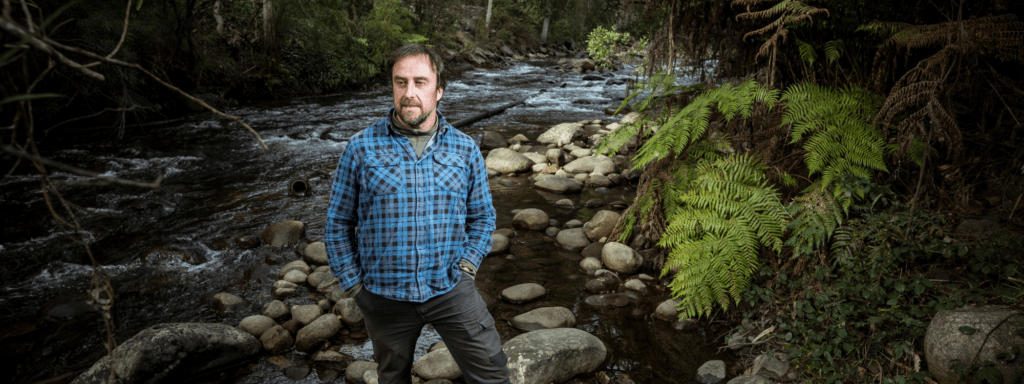
After all these years at EJA, is there a case, campaign or piece of work that has particularly stayed with you?
Many, if not most.
But I’ll pick the series of Tribunal cases I did in the Wimmera, which focused on trying to save a few old, scattered farm paddock trees.
Most of that landscape has been cleared for agriculture. Scattered paddock trees are really important remnants and “islands” of biodiversity in those landscapes – or, as the Tribunal found, “keystones” in those landscapes.
I had the chance to drive past there last summer.
“Those trees are still there doing what trees do.”
Dr Bruce Lindsay
You took a sabbatical in 2025 to spend time with family, do some serious hiking and see where things led. Did stepping away change how you thought about work, or what you wanted to come back to?
Among other things, I had the opportunity to work for the land council in Darwin during that year.
It was really good to use the skills and knowledge I had in a very different context and occasionally get pushed well out of my comfort zone. The Top End is an extraordinary place with extraordinary contradictions.
Otherwise, I did get to paddle down some rivers and do the South Coast Track in Tasmania again – for the last time, as it nearly broke me this time!
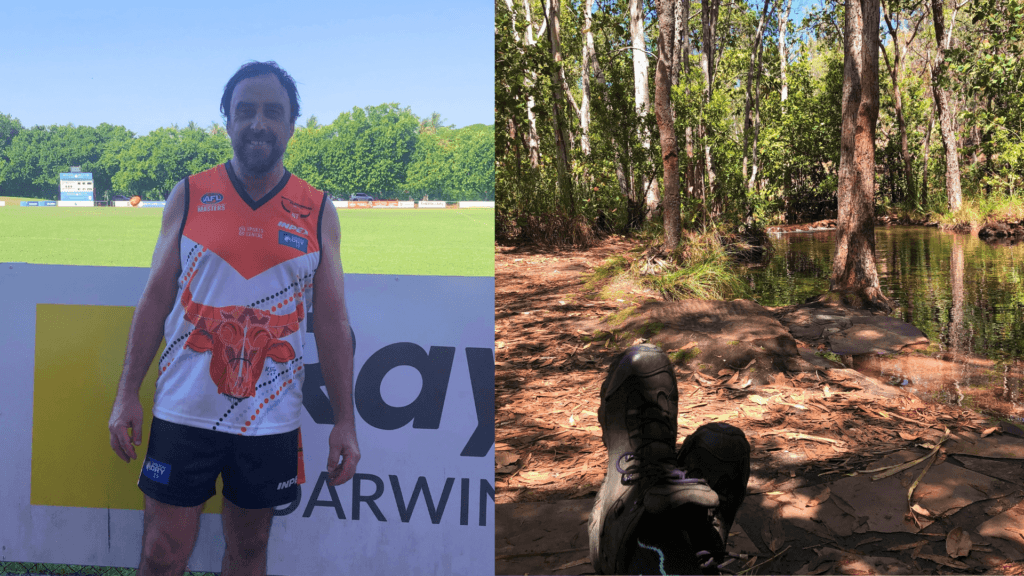
You live on Wadawurrung Country, so your commute involves some biking, a train, and then more pedalling across the city. Is that thinking time, decompression time, or just the most Bruce possible way to get to work?
I’m still waking up on the V/Line commute from Geelong.
There is a lot to be said for any early morning bike ride. I used to sometimes do an early morning Corio Bay swim beforehand too.
I haven’t done that for quite a while.
I reckon I’m getting soft.
After all these years, what still makes you curious, hopeful or fired up enough to keep doing this work?

Thinking across law, science, policy and sometimes philosophy and literature.
There are amazing, impressive people to work with: my EJA colleagues, our clients and partners, colleagues in the profession, experts, and the community with and around us.
The situation in the world is unfortunately getting no less dire.
I think it is urgent that public interest environmental lawyering remains relevant, forceful, an antidote to cynicism, and a means of possibility.
Meet more of our people




Make a difference
The challenges we face are vast. The time to push for large-scale system change is now.