SUBMISSION GUIDE
Have your say: Safeguard Mechanism Review
Our only federal climate pollution reduction legislation is being reviewed – this is your chance to have a say
Until Friday 18 September 2026, the Australian government is inviting people and organisations to have their say on the Safeguard Mechanism – Australia's main federal climate pollution reduction legislation and its main policy for reducing climate pollution from industry.
Big companies covered by the Safeguard Mechanism will have plenty to say in this review. The community should too. If you care about climate change, tell the government you expect this policy to deliver real cuts to climate pollution.
Making your submission
Three easy steps
Step 1: read the guide
Scroll down for the step-by-step instructions from EJA’s legal experts – or download the PDF.
Step 2: draft your submission
Keep it short and clear – your climate story, the issues you're concerned about, and any amendments you recommend.
Step 3: lodge your submission
Upload your submission via the consultation hub.
Optional extra:
Email your submission to decision makers:
- the Minister for Climate Change and Energy, Chris Bowen;
- the Minister for Industry and Innovation, Tim Ayres; and
- MPs and Senators from your state or territory.
You can find contact details for federal MPs and Senators here.
How to structure your submission
Start with your climate story
Explain why climate change matters to you and why you decided to make a submission. You could include:
- what worries you about climate change;
- why strong, effective federal climate policy matters to you; and
- what you want the Federal Government to do to reduce climate pollution.
This personal context matters. The Safeguard Mechanism is highly technical and the industries it regulates will be closely involved in the review. Your submission can help bring the focus back to the bigger question: whether this policy is actually reducing climate pollution and protecting people, communities and ecosystems from worsening climate change.
Set out your key concerns
Be clear about the problems you see with the current Safeguard Mechanism. You can draw on the evidence and analysis from EJA’s legal experts in this guide.
Make recommendations
Explain what you think needs to change and what you want the government to do.
Good submissions generally:
- are concise and well structured;
- make their key points clear;
- explain concerns and suggest practical recommendations; and
- only include information or documents that are directly relevant.
You can find more advice from EJA on writing an effective submission here.
About the consultation
The Safeguard Mechanism is Australia’s main policy for reducing climate pollution from large industrial facilities. It requires covered facilities to keep their emissions below set limits, which decline each year. Companies can meet these limits by cutting their pollution or using carbon offsets.
The government significantly reformed the Safeguard Mechanism in 2023 and committed to reviewing how those changes are working. This consultation is part of that review.
The review is looking at whether the Safeguard Mechanism is:
- doing enough to encourage industry to reduce its climate pollution;
- providing a meaningful incentive for companies to invest in real emissions reductions;
- striking the right balance between requiring pollution cuts and allowing flexibility, including through carbon offsets; and
- setting the right requirements for industry beyond 2030.
These questions matter because the Safeguard Mechanism is one of the main tools the Australian government claims it is using to address the causes of climate change.
But the scheme has major limits. It does not address the pollution created when Australian coal and gas are burned overseas, even though exported fossil fuels make up a huge part of Australia’s contribution to the climate crisis. In section 3, we outline some of these bigger-picture climate policy issues you may also want to raise in your submission.
And if governments are going to keep pointing to the Safeguard Mechanism as evidence that climate pollution is being dealt with, then the scheme must at least deliver what it promises: real reductions in direct climate pollution from Australian industry.
This review is therefore not just about the technical design of the scheme – it is about whether Australia’s climate laws are actually delivering the climate pollution cuts we need.
You don’t need to be an expert to make a submission. The government needs to hear from people who care about climate change and expect climate policy to deliver real reductions in pollution.
You can read the full consultation paper here and EJA’s explainer on how the Safeguard Mechanism works here.
Getting started
How to lodge your submission
All submissions must be made through DCEEW’s online consultation hub
- Draft your submission: Write your submission in Word, Pages or another text editor. You can use the background information, key concerns and recommendations from EJA’s legal experts below to help structure your response. Save it somewhere easy to find, with a clear file name such as SafeguardMechanismReview_Submission_YourName.
- Open the consultation page: Go to the Safeguard Mechanism consultation page.
- Click “Make a submission”: You’ll find the button near the bottom of the page, so you may need to scroll.
- Work through the survey: Accept the privacy statement and select your publication preferences. Use the “Next” and “Back” buttons to move between pages.
- Add your personal details.
- Upload your submission file.
- Click “Submit”.
Optional: send your submission to decision-makers
You can also email a copy of your submission to:
- the Minister for Climate Change and Energy, Chris Bowen;
- the Minister for Industry and Innovation, Tim Ayres; and
- MPs and Senators from your state or territory.
You can find contact details for federal MPs and Senators here.
If you have any questions, feedback on this submission guide, need additional support or want to share your submission with us, get in touch at hello@envirojustice.org.au.
According to EJA lawyers – what are the key issues?
Environmental Justice Australia’s legal experts have identified three key areas you might like to talk about in your submission.
Scroll down to read more EJA lawyer views:
- No legal requirement to reduce climate pollution
- Carbon credits and integrity
- Australia's climate ambition
No legal requirement to reduce climate pollution
Key points
- Companies covered by the Safeguard Mechanism are not legally required to reduce their direct climate pollution.
- Instead, they can meet their pollution limits by either reducing onsite emissions or buying carbon credits.
- In practice, most companies are relying heavily on carbon credits rather than making real changes to reduce pollution at the source.
MORE DETAIL
The Safeguard Mechanism is created through the National Greenhouse and Energy Reporting Act 2007 and the Safeguard Mechanism Rules 2015. These laws set the scheme’s goals, determine which facilities are covered and how their pollution limits are calculated.
But nowhere do they create a clear legal obligation for companies to actually reduce their direct climate pollution.
Instead, companies can choose between investing in cleaner technology or buying carbon credits.
This means the country’s biggest industrial polluters are free to keep polluting – and even to increase their direct climate pollution – under what is supposed to be Australia’s main climate policy. This is a big problem: some of the issues with offsets are described below.
Carbon offsets do have a role as a stopgap measure to store more carbon in the short-term while green alternatives to fossil-reliant systems are worked out and implemented. But because the Safeguard Mechanism doesn’t put a cap on the use of carbon offsets, they become an end goal rather than the temporary band aid they’re supposed to be.
Recommendations:
- The Safeguard Mechanism Rules should be amended to limit how much companies can rely on carbon credits to meet their pollution limits.
- That limit should become tighter over time, encouraging companies to prioritise real onsite pollution reductions.
- The Government could also set different carbon credit limits for different sectors, recognising that some industries have fewer immediate options to reduce pollution than large, highly profitable coal and gas companies.
- For example, a small cement works with limited pollution reduction technologies available now could be permitted to use more credits than a multinational coal company with the capacity to invest in methane reduction technology and electric machinery now.
Carbon credits and integrity
KEY POINTS
- Companies are overwhelmingly relying on carbon credits rather than directly reducing their climate pollution. That means the Safeguard Mechanism is not effectively reducing industrial climate pollution and not addressing the cause of climate change.
- Carbon offsets do not provide a like-for-like substitute for cutting fossil fuel pollution, and some Australian carbon credits have serious integrity problems.
- Safeguard Mechanism Credits can also be issued for reductions that do not come from genuine investment in cleaner operations.
MORE DETAIL
Companies are overwhelmingly relying on carbon credits
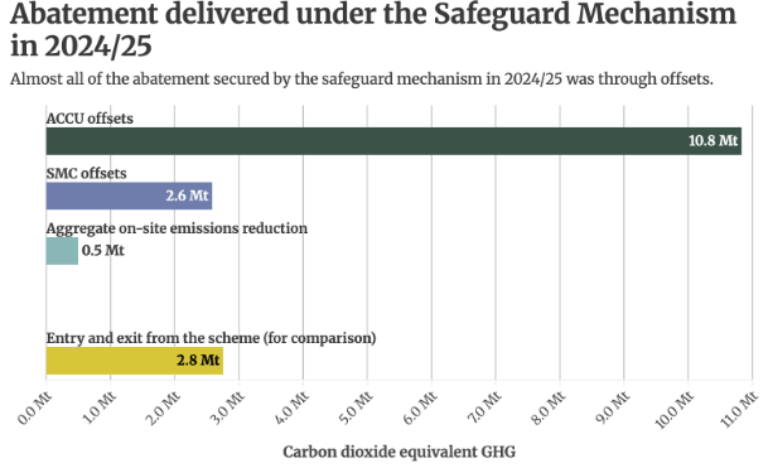
For many companies, buying carbon credits is easier and cheaper than changing how their facilities operate. The evidence from the first years of the reformed Safeguard Mechanism shows companies are relying far more heavily on credits than on reducing pollution at their own facilities.
The graph below, produced by Naru Research from data released by the Clean Energy Regulator, shows that in 2024/25, companies used 10.8 million tonnes worth of carbon credits to meet Safeguard Mechanism pollution limits, compared to delivering just 0.5 million tonnes worth of actual pollution reduction.
This is a problem for several reasons.
- First, industrial pollution is not actually falling at the source. Buying a carbon credit does not reduce the pollution produced by the facility itself. Companies can continue producing climate pollution while paying for reductions or carbon storage somewhere else.
- Second, carbon offsets do not truly compensate for fossil fuel pollution. Much of Australia’s offsetting system relies on storing carbon in plants and soils. That carbon can be released again through fire, decay or land clearing. Fossil fuels, by contrast, contain carbon that has been stored underground for millions of years. Using a temporary store of carbon to compensate for releasing fossil carbon into the atmosphere is not a like-for-like exchange.
- Third, some carbon credits do not represent genuine additional pollution reductions. Independent research has raised serious concerns about whether some Australian Carbon Credit Units represent additional climate benefits beyond what would have happened anyway. If a credit used by a company to compensate for its climate pollution does not represent a real, additional reduction in pollution elsewhere, then it doesn’t offset that company’s pollution – and overall pollution still increases.
It is true that for some sectors, projects to reduce onsite climate pollution have a long lead-in time or are still being developed – like for cement or ceramics manufacturing. However, other companies have demonstrated options available to them right now. Mining companies could electrify their machinery, coal companies could capture and use the fossil gas released from coal mining for electricity gas companies could improve how they detect and manage gas leaks.
With no direct legal obligation on companies to invest in available pollution reduction technologies, and the freedom to choose cheap carbon credits, there are real questions about whether Safeguard Mechanism is effectively targeting industrial climate pollution.
Safeguard Mechanism Credits have serious integrity issues
There is also a separate integrity problem with Safeguard Mechanism Credits.
Companies can earn these credits when their reported pollution falls below their Safeguard Mechanism limit. But there is currently no requirement to show that this reduction resulted from deliberate and lasting changes to the way the facility operates.
Sometimes reported pollution falls because production temporarily drops or a facility experiences an unexpected shutdown. A company can still receive Safeguard Mechanism Credits, then save or sell those credits so they can be used to meet pollution limits in future.
For example, Shell received $200 million worth of free credits last year just because of interruptions in production due to safety incidents! And Shell can now use those credits to comply with its pollution limit for years into the future, rather than fixing methane leaks or otherwise reducing onsite pollution.
That means the scheme can effectively reward companies that have not actually invested in cleaner technology – and enable those companies to avoid real pollution cuts later.
Recommendations:
- limit how much companies can rely on carbon credits to meet their Safeguard Mechanism pollution limits, with that limit becoming tighter over time
- require companies to publish – and implement – credible plans showing how and when they will reduce climate pollution from their own operations
- require independent verification that reductions in pollution result from durable changes in operations before issuing Safeguard Mechanism Credits
Australia's climate ambition
KEY POINTS
- The Safeguard Mechanism only deals with a small part of Australia’s contribution to climate change. It does not address the pollution created when Australian coal and gas are burned here or overseas.
- Australia needs a clear plan to phase out fossil fuel production, alongside stronger pollution reduction targets under the Safeguard Mechanism.
- Government policies should work together to reduce climate pollution – not send conflicting signals by asking industry to cut pollution while subsidising diesel use.
- Coal and gas companies should face stronger requirements than industries that need to transition to cleaner production.
MORE DETAIL
Despite what the Government says, the Safeguard Mechanism is not enough to deal with the climate crisis.
The scheme regulates direct pollution from large industrial facilities, including the pollution created while extracting coal and gas. But it does not address the much larger amount of pollution created when those fossil fuels are burned to generate energy overseas.
This means the Safeguard Mechanism only captures a small part of the climate impact of Australia’s fossil fuel industry.
Australia needs a broader plan for moving away from fossil fuels. Without one, workers and communities, clean energy industries, Australia’s trading partners and people worried about climate change are all left without a clear picture of how and when this transition will happen.
The Safeguard Mechanism should support that transition. Pollution limits under the scheme currently decline each year, but the settings are only confirmed to 2030. The Government now needs to determine how quickly they decline between 2030 and 2035.
Those settings should reflect the strongest end of Australia’s national climate ambition. The Safeguard Mechanism should be calibrated towards the upper end of Australia’s 2035 climate pollution reduction target – a 70% reduction on 2005 levels.
It should also recognise that not every industry covered by the scheme has the same future. Manufacturing, freight and other essential industries need to transition away from fossil fuels. Coal and gas production itself needs to be phased out.
That means coal and gas producers should face stronger pollution reduction requirements, particularly for new facilities.
Fuel tax credits are working against climate action
Government policies also need to work together.
Under the Fuel Tax Credits Scheme, companies can claim credits for the fuel tax paid on diesel used in trucks, machinery and other equipment. In practice, this makes diesel cheaper for businesses that receive the credit.
That matters for the Safeguard Mechanism because diesel is a fossil fuel and burning it creates climate pollution. Mining companies are the biggest recipients of fuel tax credits – while also being among the companies the Safeguard Mechanism is supposed to encourage to invest in cleaner machinery.
Electrifying trucks and mining equipment is one of the available ways these companies can reduce their direct pollution. But the Government is sending conflicting signals: the Safeguard Mechanism is supposed to encourage companies to move towards cleaner technology, while the Fuel Tax Credits Scheme makes continuing to use diesel cheaper.
Combined with the Safeguard Mechanism’s generous access to carbon credits, this weakens the incentive for companies to invest in genuine onsite pollution reductions.
For example, Climate Integrity found that for every $1 Glencore paid to comply with the Safeguard Mechanism, it received $41 in fuel tax credits.
If the Government wants the Safeguard Mechanism to drive real changes in industry, it needs to stop other policies from working against it.
Recommendations:
- develop a clear plan for phasing out fossil fuel production and managing a fair transition for workers, communities and industries;
- set ambitious Safeguard Mechanism pollution targets for 2030–35 that recognise the urgency of reducing climate pollution – at the very least, targets should align with the upper end Australia’s 2035 climate target – a 70% reduction on 2005 levels;
- and cap Fuel Tax Credits for mining and resources companies, so public money is not undermining the Safeguard Mechanism’s incentive to invest in cleaner technology.
More helpful resources
Need more information? Explore EJA’s library of environment law reform analysis, legal explainers and video briefings:
Our financials
We have a long-standing commitment to sound fiscal management, accountability and transparency.
We encourage you to investigate before you donate.
Join us
The law is a powerful tool to disrupt the status quo and make governments and corporations accountable.
Join us and let's build a radically better world.