Environment law reform
Safeguard or smokescreen?
Why the Albanese government’s climate excuse doesn’t stack up
We’re living in a climate crisis, and Australia’s national environment laws urgently need to confront climate harm head-on.
Yet right now, the Albanese Government is refusing to include a climate trigger or assessment of climate harm in Environment Protection and Biodiversity Conservation (EPBC) Act reforms. They claim it would duplicate the Safeguard Mechanism.
But this is simply wrong. The Safeguard Mechanism does not prevent climate damage to our environment. It does not assess projects, it does not stop pollution, and it does not protect threatened species or ecosystems from global heating.
Hear from EJA lawyer Sam Moorhead on why the Safeguard Mechanism simply does not replace strong climate safeguards in our environment laws – and what’s at stake if the government gets this wrong.
The Safeguard Mechanism does not protect Australia’s threatened species and ecosystems from climate change.
The Safeguard Mechanism covers about 220 industrial facilities collectively responsible for just under 30% of the greenhouse gas pollution produced every year in Australia. It applies emissions caps to the direct (‘scope 1’) emissions produced by those facilities. Following Labor’s reforms in 2023, these caps will grow tighter each financial year.
Minister Watt and Prime Minister Albanese are refusing to include climate change in the new EPBC Act on the basis that this would duplicate the work of the Safeguard Mechanism.
This is not true.
The Safeguard Mechanism is not a substitute for incorporating climate considerations into federal environmental decision-making and it will not protect Australia’s people, ecosystems or threatened species from climate change.
This is because:
- The Safeguard Mechanism does not prevent greenhouse gas emissions. It does not require on-site emissions avoidance or reduction. Instead, companies have unlimited discretion to surrender carbon credits for compliance with facility emissions caps.
- The Safeguard Mechanism is not an assessment or approvals system. It does not require, or even allow for, any federal decision-maker with approvals power to consider whether the greenhouse gas emissions to be produced by proposed projects are compatible with Australia’s emission reduction targets, or with limiting global warming to 1.5 degrees, and to prevent unacceptably polluting projects from going ahead.
- In relation to the coal mines and gas fields covered by the Safeguard Mechanism, only emissions produced on-site are subject to the Mechanism’s emissions caps. This represents a small fraction of the total pollution resulting from fossil fuel production. Most harm to Australia’s ecosystems comes from the end-use of coal and gas after it is sold by extraction companies.
- The Safeguard Mechanism does not differentiate between fossil fuel production and other, less replaceable industries. Where fossil fuel exports have no place in an economy compatible with limiting global warming to survivable temperatures, other industries like manufacturing and transport are less replaceable and should be supported to decarbonise.
There are also problems with how Labor’s 2023 reforms to the Safeguard Mechanism have been implemented, which undermine its ability to encourage decarbonisation in Australian industry.
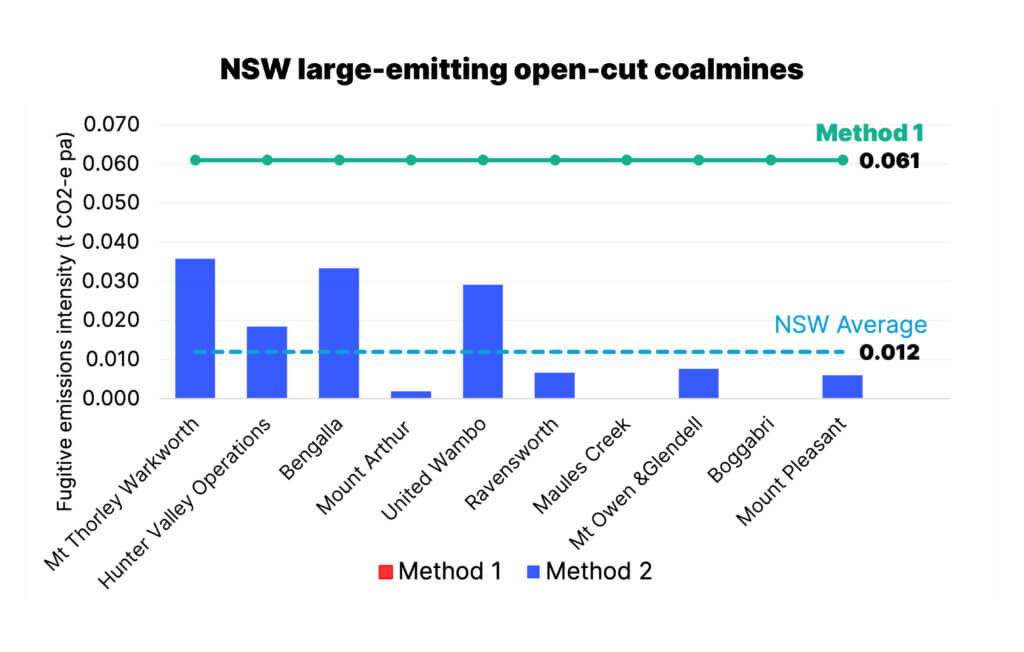
First, companies can switch emissions accounting methods to bring down their ‘on-paper’ emissions without actually reducing pollution. In 2024, open-cut coal mines in NSW switched to a different emissions calculation method. This shift drastically reduced the mines' reported emissions, as shown in the graph below, but there was no actual reduction in the greenhouse pollution from their coal mining.
Not only does this illustrate that what looks like progress towards the Safeguard emissions reduction targets might actually reflect creative accounting rather than genuine decarbonisation, these mines earned Safeguard Mechanism credits for reporting emissions below their baselines – credits that can be banked and used for future compliance, further delaying investment in technologies to bring down emissions.
Second, almost all the fossil fuel projects currently proposed in Australia will probably avoid the more stringent baselines supposed to be given to ‘new facilities’. The imposition of more stringent emissions caps on new facilities was a central component of the 2023 reforms, but it stands to be thoroughly ineffective in relation to fossil fuel projects.
- For example, it is likely that Santos’ proposal to extract gas from the undeveloped Barossa field would be treated as part of the existing Darwin LNG plant facility, rather than a ‘new’ facility for Safeguard purposes.
- Similarly, 28 of the 35 coal projects currently seeking EPBC approval involve expansions or life extensions to existing mines and will probably not be treated as new facilities, even where they comprise the construction of entirely new mine pits.
- The same is true for 10 of the 16 coal projects approved by the Labor Government since 2023.
This means that the emissions caps applicable to new coal and gas extraction will be calculated by reference to old emissions intensity factors, resulting in more lenient treatment of new fossil fuel projects than other sectors, and undermining the policy objective of encouraging companies investing in new developments to choose best-available emissions reduction technology in designing their projects.
Finally, as long as covered facilities have unlimited capacity to surrender carbon credits to comply with the Safeguard caps, coal and gas companies have minimal incentive to invest in on-site decarbonisation – meaning that industrial emissions won’t actually decline. Fossil fuel production and processing sites accounted for 103 of the 219 facilities covered by the Safeguard Mechanism in 2023-24. Sixty-seven of these facilities reported scope 1 emissions higher than their emissions cap and collectively surrendered 4.65 million Australian Carbon Credit Units to comply with their Safeguard obligations, well over half of the 7.15m ACCUs surrendered by Safeguard facilities overall.
The Safeguard Mechanism is not a complete climate policy and does not replace the need for climate considerations in federal environmental decision-making
Structural limitations in the Safeguard Mechanism mean that incorporating climate considerations into the reformed EPBC Act would not duplicate the requirements of the Mechanism. Instead, including climate impacts in environmental impact assessment would fill fundamental gaps in Australia’s emissions reduction framework by creating a clear and sensible pathway for responsible decision-making to regulate unacceptable greenhouse gas pollution.
| GAPS IN THE SAFEGUARD MECHANISM | SOLUTIONS FROM INCORPORATING CLIMATE HARMS INTO THE EPBC |
|---|---|
| No forward-looking assessment of whether proposed facilities’ emissions are compatible with Australia’s national targets prior to project approval | Expected emissions from proposed actions and compatibility with targets form part of environmental impact assessment and are factored into approval decision |
| No avenue for Minister/regulator to reject proposed facilities whose emissions are incompatible with Australia’s targets | Unacceptable or target-incompatible emissions impacts could form the basis of refusal decision |
| Does not actually limit or prevent emissions with unlimited ability for facilities to surrender carbon credits instead of investing in on-site emissions abatement | Ability for approval decisions to impose project-specific conditions requiring implementation of available on-site abatement technologies, resulting in real emissions reduction/avoidance |
| No guarantee of offset integrity with many offsets locked into the market that have provided no carbon abatement at all | Approval decisions could impose conditions requiring the surrender of higher-integrity offsets where on-site abatement not possible |
| Lack of flexibility in methods used to estimate emissions is leading to chronic under-reporting of methane emissions, even when better data is available | Environmental impact assessments could be tailored to allow for the most accurate emissions data available to be used |
| No coverage or consideration of downstream (‘scope 3’) exported emissions from Australian fossil fuel production, potentially breaching international law | Environmental impact assessment would cover the full scope of proposed actions’ potential harm to protected ecosystems, including the clearly foreseeable harm resulting from the end-use of exported coal and gas |