Legal update: Hearing day summary
Narrabri Lateral Pipeline hearing
This case has now concluded.
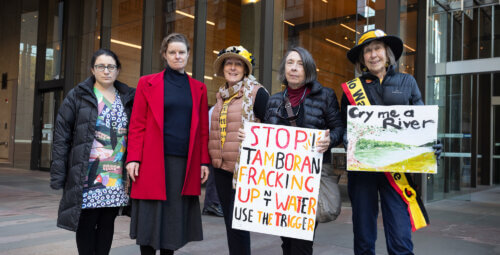
The Federal Court heard submissions today regarding the legal challenge of the Environment Minister’s decision not to apply key water protections to the Narrabri Lateral Pipeline (NLP), in north-west New South Wales.
This legal update provides factual information about the hearing which took place today.
When: 9:30am, Monday 1 December 2025
Where: Federal Court of Australia, Sydney (184 Phillip St, Sydney)
Background
Community group Mullaley Gas & Pipeline Accord (MGPA) Inc. sought judicial review of a decision made by a delegate of the Federal Environment Minister under section 75 of the Environment Protection and Biodiversity Conservation Act 1999 (Cth) (EPBC Act), in which the delegate decided not to apply the ‘water trigger’ to the Narrabri Lateral Pipeline (NLP).
The NLP is a proposed 50-60km gas pipeline enabling the transport of gas from the Narrabri Gas Project, an 850-well coal seam gas development near Narrabri and the Pilliga Forest.
The 1-day hearing commenced this morning before Justice Thawley.
The ‘water trigger’
Under ss 24D and 24E of the EPBC Act, the ‘water trigger’ requires additional scrutiny of projects that:
- involve unconventional gas development (such as coal seam gas), and
- are likely to have a significant impact on a water resource.
In the present case, the Minister’s delegate determined that the NLP did not ‘involve’ an unconventional gas development, thereby not engaging the first limb of the ‘water trigger’.
The parties’ submissions
MGPA argue that the Minister’s delegate made an error of law in finding that ss 24D and 24E of the EPBC Act are not controlling provisions for the proposed action, and seek the decision to be remitted to the Minister to be made according to law.
The Minister and the proponent of NLP, Hunter Gas Pipeline Pty Ltd (a wholly owned subsidiary of Santos), are arguing that the decision not to apply the ’water trigger’ provisions was properly made.
At the outset, Senior Counsel for MGPA, Catherine Gleeson SC, set out the legislative framework and context relevant to the proper interpretation of the provisions, drawing in particular upon the Federal Court’s findings in Australian Conservation Foundation Inc v Minister for the Environment [2001] FCA 550 (ACF). Ms Gleeson outlined how the relevant authorities and the legislative context call for a broad interpretation of the phrase ‘involving’ an ‘unconventional gas development’ which is not confined to the physical extraction of coal seam gas. Ms Gleeson submitted to the Court that this interpretation accords with the purpose of the provisions to guard against potential significant impacts of gas and coal development on water resources, and the environmental protective purpose of the EPBC Act more generally. Ms Gleeson submitted that the Minister’s delegate had applied an overly restrictive test and failed to properly consider the close link between the NGP and the NLP, and had therefore made an error in deciding not to apply the ‘water trigger’ provisions.
Senior Counsel for Hunter Gas Pipeline Pty Ltd (the Second Respondent), Vanessa Whittaker SC submitted that the Minister had not failed to correctly identify or correctly apply the relevant test. Ms Whittaker argued that the legislative context for the ‘water trigger’ provisions and the Court’s previous guidance in ACF does not call for such a broad interpretation. The NLP, according to the Second Respondent, is too far removed from the extractive process to be captured by the provisions.
Senior Counsel for the Minister for the Environment and Water (the First Respondent), Nick Wood SC, followed with brief submissions echoing the Second Respondent’s position. Mr Wood relied upon case law regarding the scope of “mining operations” and emphasised a distinction between raw gas and saleable end-product gas when arguing that the NLP was too far removed from the extraction of gas to satisfy the relevant provision.
In reply, Ms Gleeson emphasised the importance of the practical and commercial realities that tie together the NLP and the NGP. Ms Gleeson reminded the Court that the consideration of whether an action is sufficiently linked to an unconventional gas development so as to ‘involve’ it is a question of fact and degree that will depend on the specific circumstances of the action.
Next steps
Justice Thawley has reserved judgment in this case, meaning the Court will deliver a decision and reasons for that decision at a later date.