
Environment law draft reform package
Scorecard
This scorecard assessed the EPBC Act law reform package introduced to Parliament in 2025. The legislation has since passed and implementation of the new laws is underway.
After years of promises, the Albanese government has finally tabled its long-awaited environment reform package in Parliament.
EJA’s legal experts have analysed the seven bills and 1,500 pages of amendments to create a scorecard – an independent assessment of what’s strong, what’s weak, what’s been removed, and what needs to improve.

The Environment Protection and Biodiversity Conservation Act 1999 (EPBC) Act is Australia's national environment law. It's meant to be a safety net that protects nature from unacceptable destruction. Everyone agrees it needs an overhaul.
With the climate and extinction crises pushing our life support systems to the brink – and industry pushing for weaker protections and faster approvals – the stakes for this reform couldn't be higher.
Have your say
A Senate Inquiry is inviting public submissions between now and 5 December 2025. EJA's submission guide walks you through the process, explains what’s at stake and highlights the biggest fixes needed to make these laws actually protect nature.
See the step-by-step guide: www.envirojustice.org.au/have-your-say-epbc-reform-package
SCORECARD
How does the reform package stack up overall?
EJA's legal experts have analysed the 1500 page draft reform package and independently analysed the Albanese Government's plans against what’s really needed to protect nature and tackle climate damage.
These are our first impressions as at 31 October 2025 – we will continue to update this scorecard and the analysis below as new information comes to light.
Here's our analysis of how the reforms stack up:
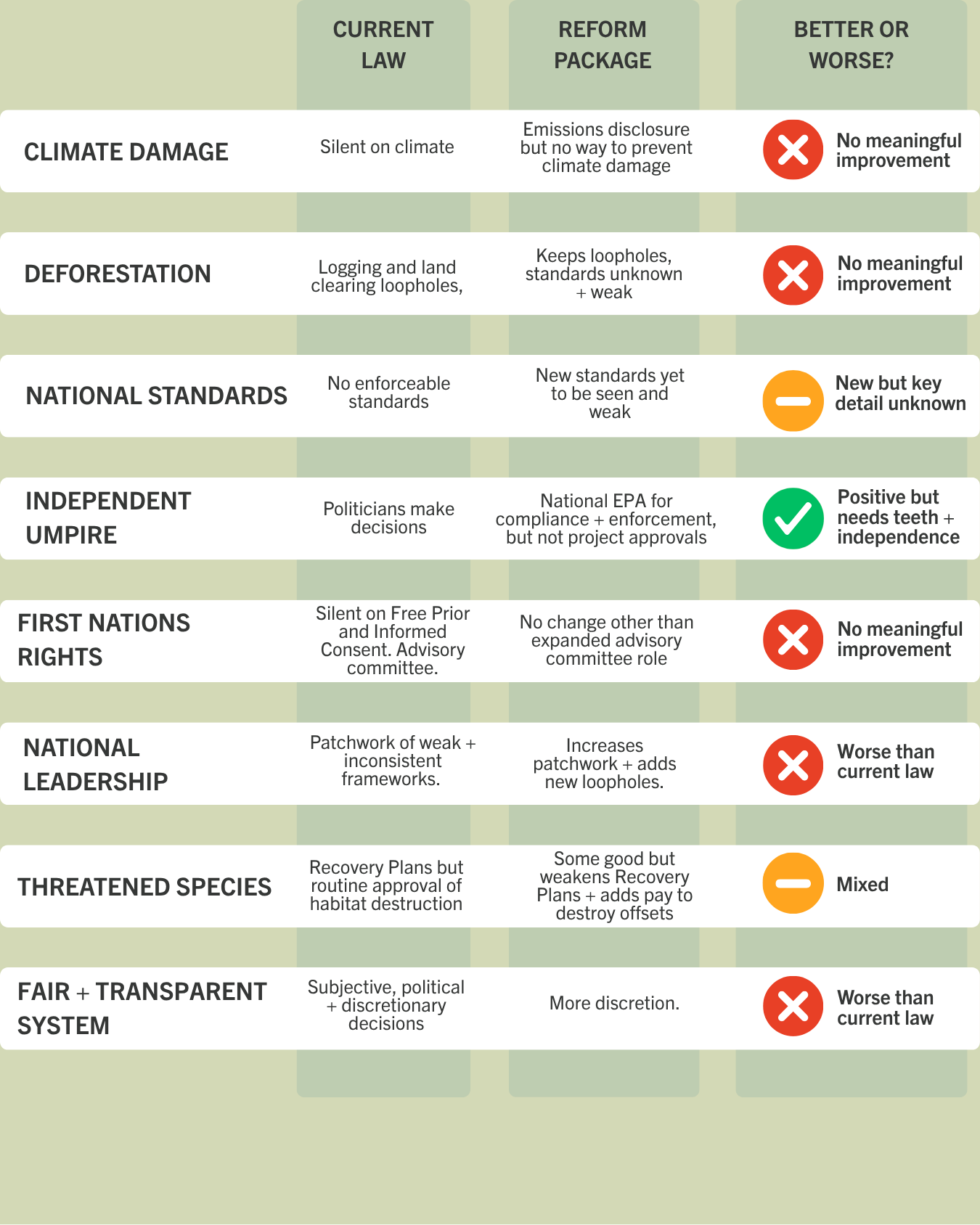
EJA's scorecard assesses the reforms against against the existing powers within the EPBC Act as well as a set of tests of success that reflect what independent environmental law experts say is needed to fix Australia’s environment laws.
Focus improvements
The reforms are assessed across key focus areas, with clear tests of success – for example, whether there are strong, legally binding national environmental standards; or whether all projects are required to disclose and be assessed for their climate harm.
Weighting
Not all tests carry the same importance. Each is weighted to reflect its significance (e.g. national standards carry more weight than non-regression principles).
Scoring
Each test is scored based on whether the draft reforms:
- Fully meet the test – clear, binding commitments in the legislation (full points).
- Partially meet the test – vague or incomplete commitments (half points).
- Do not meet the test – absent or regressive (zero points).
- Incomplete – where no detail has been released, the test is marked “?” and no points are awarded.
Totals
Weighted scores are added to create a total out of 100 for each focus area. These totals are expressed using a simple traffic-light scale:
0–25 = Fail (red)
26–74 = Needs improvement (yellow)
75–100 = Pass (green)
A closer look
Climate damage
Climate change is reshaping the world we live in. We cannot protect nature, communities or cultural heritage without embedding climate science into every decision – and ensuring our laws reflect the reality of the climate crisis.
So how does the draft reform package stack up?
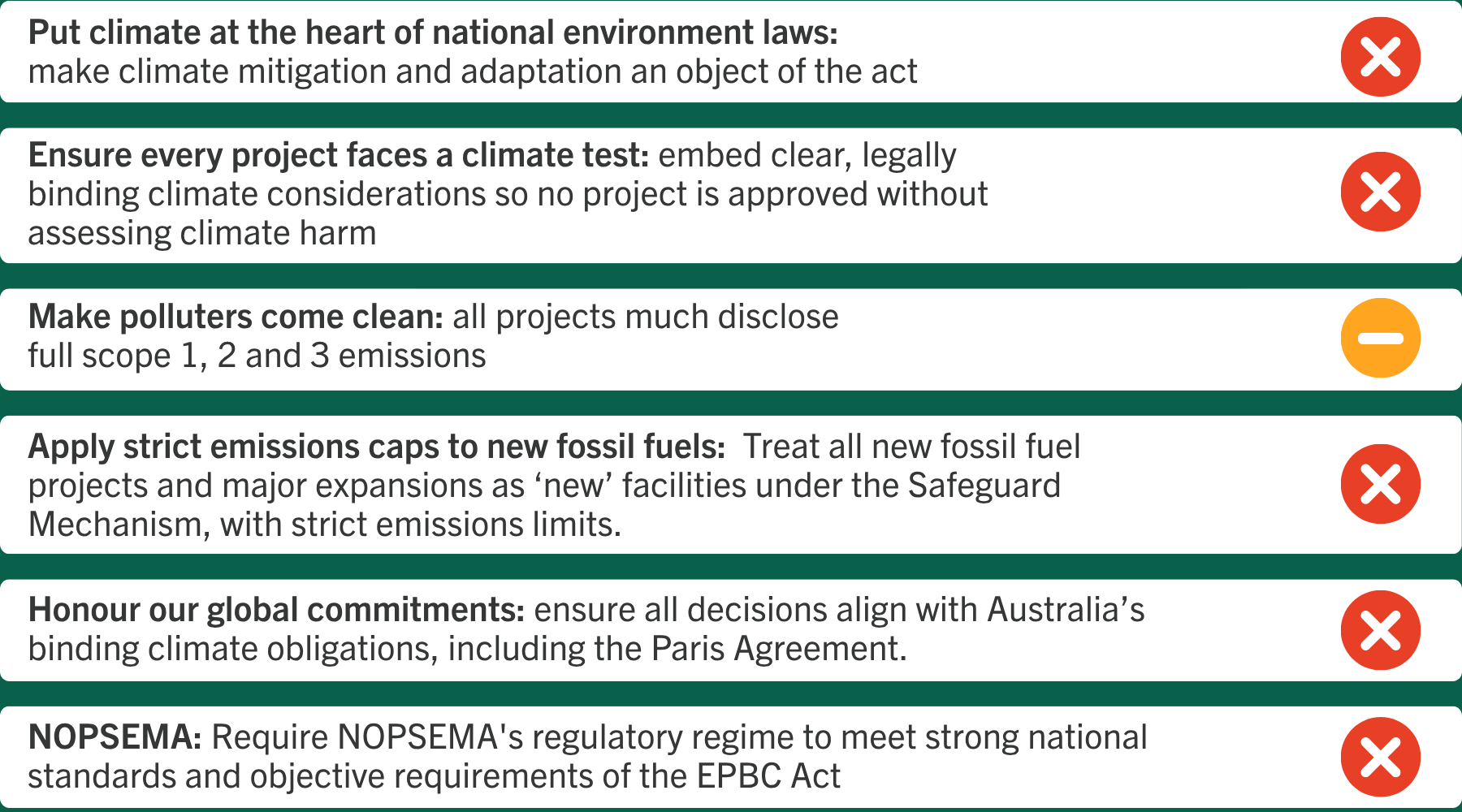
Here's the detail:
The current EPBC Act is effectively silent on climate change.
Coal and gas projects are assessed for local impacts on protected places and species, while their biggest threat – the climate damage they unleash – isn’t on the checklist.
That loophole means Environment Ministers can approve fossil fuel projects without properly weighing their climate harm to species, ecosystems and communities. (The government likes to spruik the Safeguard Mechanism as a substitute but read why this is a smokescreen, not a substitute.)
Actions assessed under certain state laws – and by NOPSEMA (the National Offshore Petroleum Safety and Environmental Management Authority, which regulates offshore oil and gas) – are required to provide scope 1, 2 and 3 emissions information.
Some proponents of fossil fuel projects also voluntarily provide emissions assessments for projects assessed under the EPBC Act directly – but even then, the emissions still are not a mandatory factor in decision-making.
The Albanese Government’s current draft reform package would require projects to disclose their scope 1 and 2 emissions, if above a prescribed threshold, and to describe the strategies they intend to use to ‘manage’ those emissions.
However the bill does not currently require proponents to actually reduce their greenhouse gas pollution, or even to disclose the amount of downstream or “scope 3” emissions they expect their activities will cause.
It also doesn’t require the Minister to consider the emissions information in their decision about whether to approve the project.
That means that physically direct emissions (like smokestacks at a power plant) and indirect emissions (like those produced by generating electricity brought in from off-site) would need to be disclosed. But the emissions from the burning of coal, oil, and gas produced and sold from fossil fuel projects would not be. And none of this information about a project’s potential contribution to climate change will be weighed up in assessing the project’s environmental impacts.
You may have seen headlines saying Labor has ruled out a “climate trigger” in its proposed reforms. In this context, a trigger simply means a checkpoint that potential harm from a project is assessed against. For example, in the current laws there are “triggers” for threatened species and water resources, so projects that might damage them have to go through assessment. But there is no trigger or checkpoint for assessing climate damage. Labor’s proposed reforms do not change this.
The current draft legislation also enables the Environment Minister and NOPSEMA to disregard important existing safeguards for offshore gas and petroleum projects assessed by NOPSEMA (the National Offshore Petroleum Safety and Environmental Management Authority). This could have a significant impact on requirements for genuine consultation with First Nations communities and undermine proper environmental assessment.
To fix these issues and gaps, EJA's legal experts call on government to amend the draft reform package:
1. Require full disclosure of emissions
Projects should have to disclose their scope 1, 2 and 3 emissions and be assessed against future climate scenarios.
Scope 3 emissions are by far the biggest source of climate damage from Australia’s fossil fuel projects. Without this information, decision-makers and the public can’t see the full picture of a project’s risks to people and the planet. This is not new or radical: many mining companies already report full emissions in state-based applications, and corporate disclosure laws now require companies across Australia to publish information about their full greenhouse gas emissions profile every year. Adding this requirement to national environment laws would ensure consistent, transparent information across all projects – and tie emissions information to climate change, and the impact it will have on our nationally protected species and ecosystems.
2. Climate harm added to the purpose of the law
Climate mitigation and adaptation should be added to the objects of the Act, along with reference to Australia’s international climate obligations.
3. Climate considerations embedded into the law
Introduce clear, legally enforceable climate considerations – similar to existing sustainability principles – to prevent further harm to species and ecosystems.
4. Thorough oversight of big emitters
Require any new project emitting more than 100,000 tonnes of CO2e per year to be automatically treated as a ‘new’ facility under the Safeguard Mechanism – this will close a loophole that currently means major expansions to existing coal and gas projects escape the more stringent rules that are supposed to encourage new facilities to implement emissions reduction measures from the get-go.
5. Strong environmental assessments for offshore gas and petroleum
Require that the process authorising NOPSEMA to assess offshore projects is subject to public consultation, thorough assessment and is consistent with the objectives of the EPBC Act. Ensure these projects continue to require proper consultation with impacted communities and environmental assessment.
6. Alignment of the law with global commitments
All approvals should be consistent with Australia’s international obligations, including the Paris Agreement, with the Climate Change Minister consulted where relevant.
A closer look
Deforestation and land clearing
Australia is a global deforestation hotspot – one of the few developed countries still clearing native forests at scale. We're also a global leader in extinction, and deforestation kills, injures or displaces between 50 to 100 million animals every year.
Protecting forests and habitat is essential to protecting our wildlife, safeguarding Country, and tackling climate change.
So how does the draft reform package stack up?
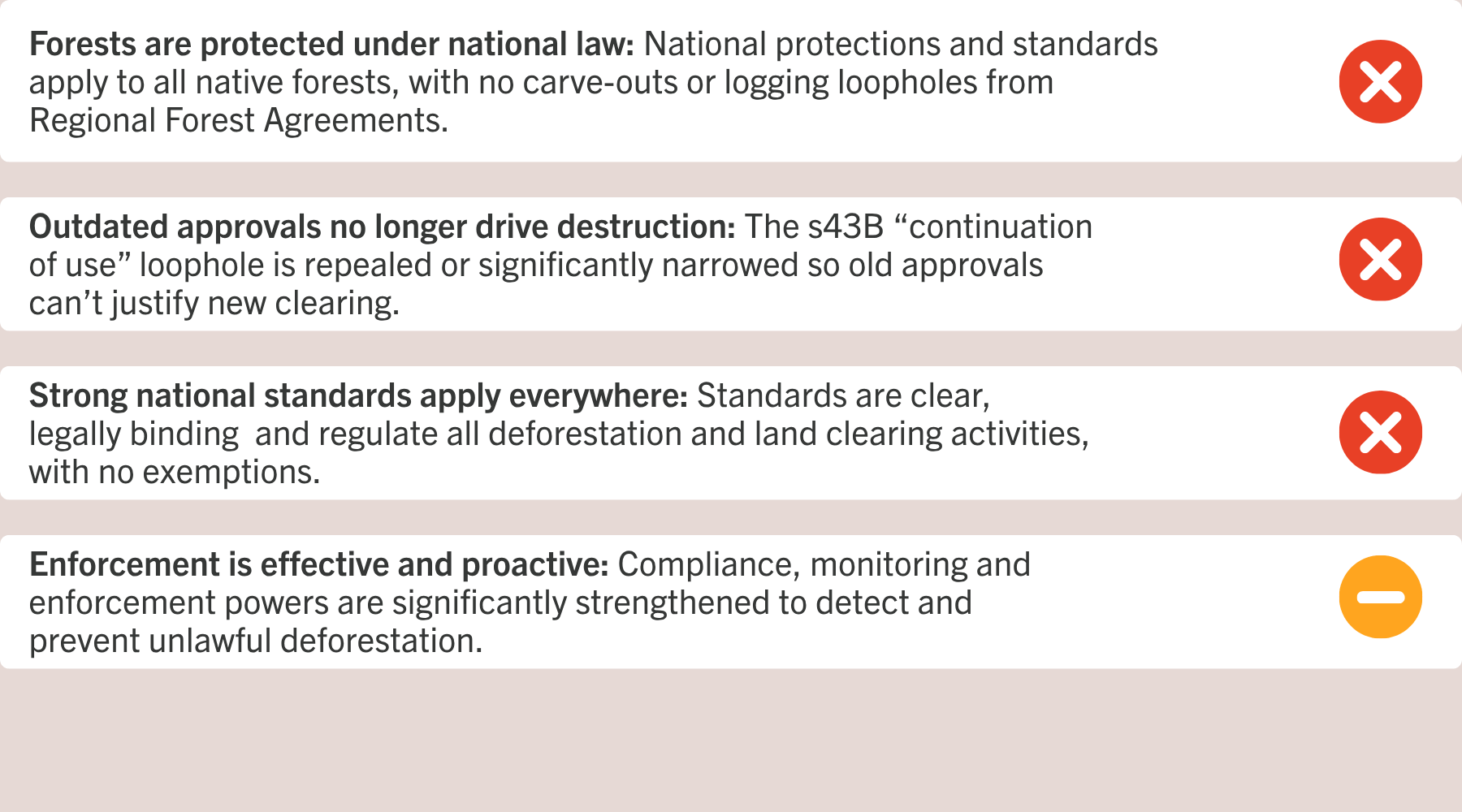
Read the detail:
Industries like native forest logging are frequently effectively exempt from our current nature laws.
Most clearing is not assessed under the EPBC Act due to "Regional Forest Agreement” (RFA) loopholes that exclude logging and limited assessment and oversight of agricultural clearing. Threatened species living in habitat covered by an RFA have no federal protection from harm, despite being nationally listed as threatened.
The “continuous use” exemption means activities such as land clearing that were occurring before 2000 are still exempt from environmental assessment.
The Albanese government’s current proposed reform package keeps these old logging and land clearing loopholes.
This means logging in forests covered by Regional Forest Agreements will continue to avoid federal environmental assessment.
The government has also refused to remove the "continuous use” exemption, which allows land clearing practices that were occurring before 2000 to continue without assessment.
The reforms will, in theory, apply National Environmental Standards to deforestation and land clearing. But we cannot see how this is the case. The current proposed reforms do not clearly apply the standards to Regional Forest Agreements.
And the reforms mean that the application of the Standards, once developed, will be highly discretionary, weak and too often, unenforceable. Under the reform package, the Environment Minister of the day would get to choose how to apply them to a project like a logging coup or industrial agricultural expansion – and with so much discretion, these standards won’t provide for uniform, reliable environmental protection for threatened species and their habitat.
The reforms mean that the application of the Standards, once developed, will be highly discretionary, weak and too often, unenforceable. Under this current draft, the Environment Minister of the day would get to choose if and how to apply them to a project like a logging coupe or industrial agricultural expansion – and with so much discretion, these standards will not provide for uniform, reliable environmental protection for threatened species and their habitat.
While there are some improvements in enforcement powers in the draft reform package, it is unclear how these will apply to deforestation if existing loopholes are not closed.
To fix these issues and gaps, EJA's legal experts call on government to:
Remove logging loopholes: Remove the Regional Forest Agreement (RFA) exemption so forests covered by RFAs are fully subject to national protections and standards.
Close the continuation of use exemption: Repeal or significantly narrow the s43B “continuation of use” exemption, which allows outdated approvals to persist even when they would not pass today’s standards.
Improve national standards so they are strong and enforceable – and apply them to all deforestation and land clearing activities.
A closer look
National environmental standards
Right now, Australia’s environment laws are failing to stop destruction. Projects that harm threatened species and destroy their critical habitat are routinely approved.
There’s no clear legal line that says “this is too damaging – it cannot go ahead,” and no strong, enforceable standards for decisions. Too often, the law permits destruction instead of preventing it.
So how does the draft reform package stack up?
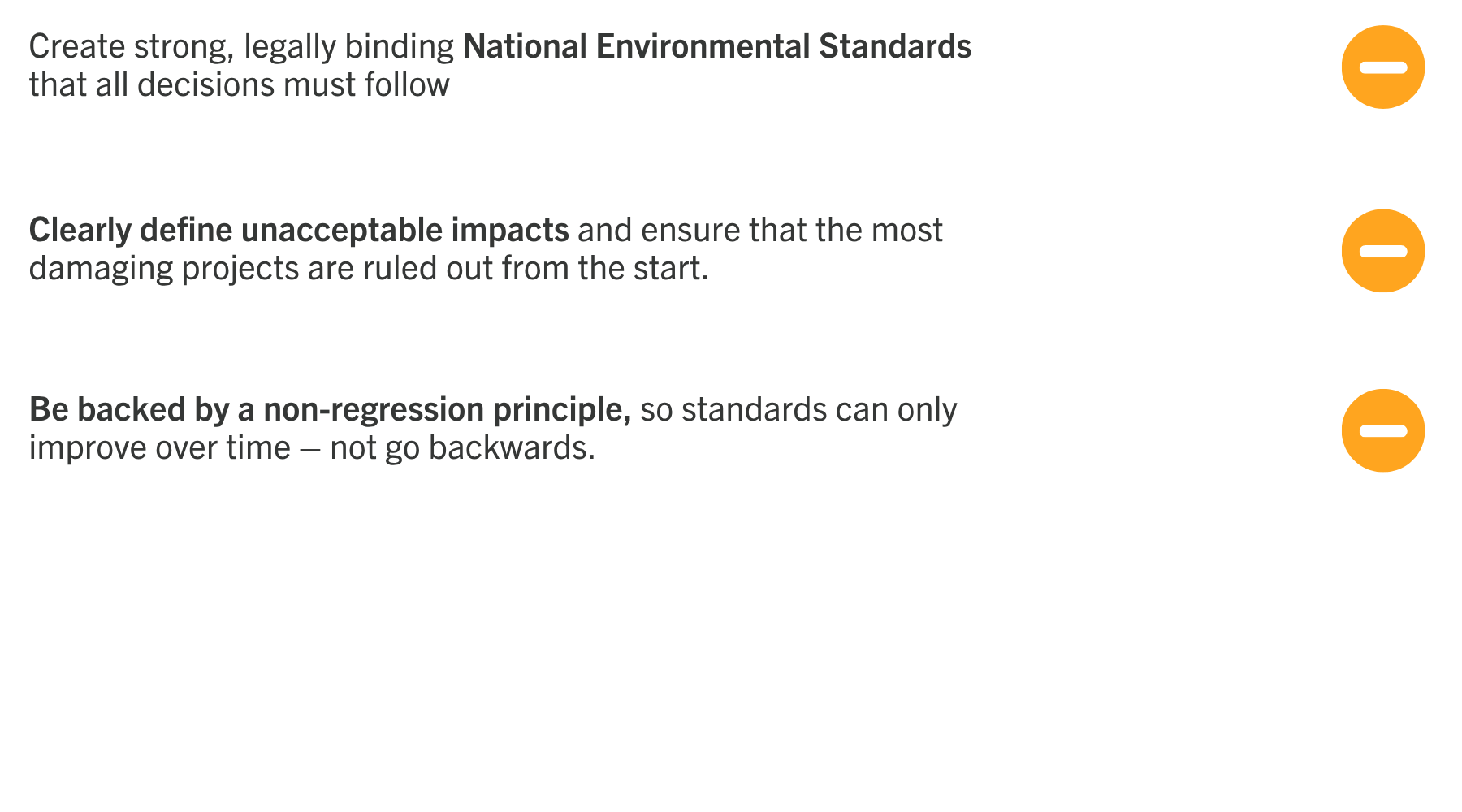
Read the detail:
Standards are common across most industries in Australia – from sunscreen to technology – but there are currently no standards in Australia’s national environment laws.
Introducing standards would bring much-needed clarity and accountability to environmental decision-making. Standards were a central recommendation of the 2020 independent Samuel Review of the laws.
The Albanese government’s reforms would give the Environment Minister new powers to make national environmental standards – a long overdue cornerstone of meaningful environment laws.
But as drafted, the standards would fall far short of what’s needed. They’re not mandatory, don’t guarantee strong environmental outcomes, and wouldn’t set a clear, enforceable bottom line for protection. Instead, they’d apply only to some decisions, and their use would be largely discretionary.
Decision-makers would merely need to “have regard to” the standards or be “satisfied” their decisions are “not inconsistent with” them – weak language that means standards could be applied inconsistently.
The draft package also includes several positive concepts, but each is undermined by significant loopholes.
A definition of “unacceptable impact” is included – an important step to ensuring that projects with unacceptable impacts on the environment cannot proceed – yet the test is subjective and set at an unreasonably high threshold.
An impact would only be deemed unacceptable if it “seriously impairs the viability of” a threatened species, while the test for water resources is limited to human interests and nationally significant sites, leaving broader ecological impacts unaddressed.
There’s a proposed mitigation hierarchy – but corporations could effectively be able to pay to override it and continue destructive activities. And while a non-regression principle is included, it’s largely discretionary and wouldn’t apply to projects within the first 18 months after a standard is made.
Together, these gaps mean that while the concept of national standards is introduced, the reforms stop well short of creating strong, enforceable rules that would deliver consistent protection for nature.
The government has now released a draft standard for matters of national environmental significance, and says that a draft offsets standard is coming soon.
But other essential standards – like First Nations Engagement and Community Participation – are still in development and we don’t expect to see them this year. This is not acceptable for standards that Samuel intended to form the cornerstone of environmental law reform that uplifted the EPBC Act to do better for nature. It is hard to see how standards like First Nations Engagement and Community Participation can provide meaningful outcomes if they are retrofitted to the Act.
The draft reforms must be amended so that all actions and decisions under the Act are required to meet the national standards, including:
- approval decisions and setting conditions for approvals
- bilateral agreement accreditations and approval declarations
- rulings
- bioregional plan decisions
- strategic assessments.
In addition, the draft laws should be amended so that:
- the non-regression principle is clearer and cannot be undermined
- the mitigation hierarchy does not allow companies to pay to destroy
- unacceptable impacts are defined in line with community expectations about protecting nature from development, and giving certainty about where and when projects cannot proceed.
The Matters of National Environmental Significance Standard should be strengthened, as it is currently weaker and less clear than what was recommended in the Samuel review.
A closer look
Independent umpire
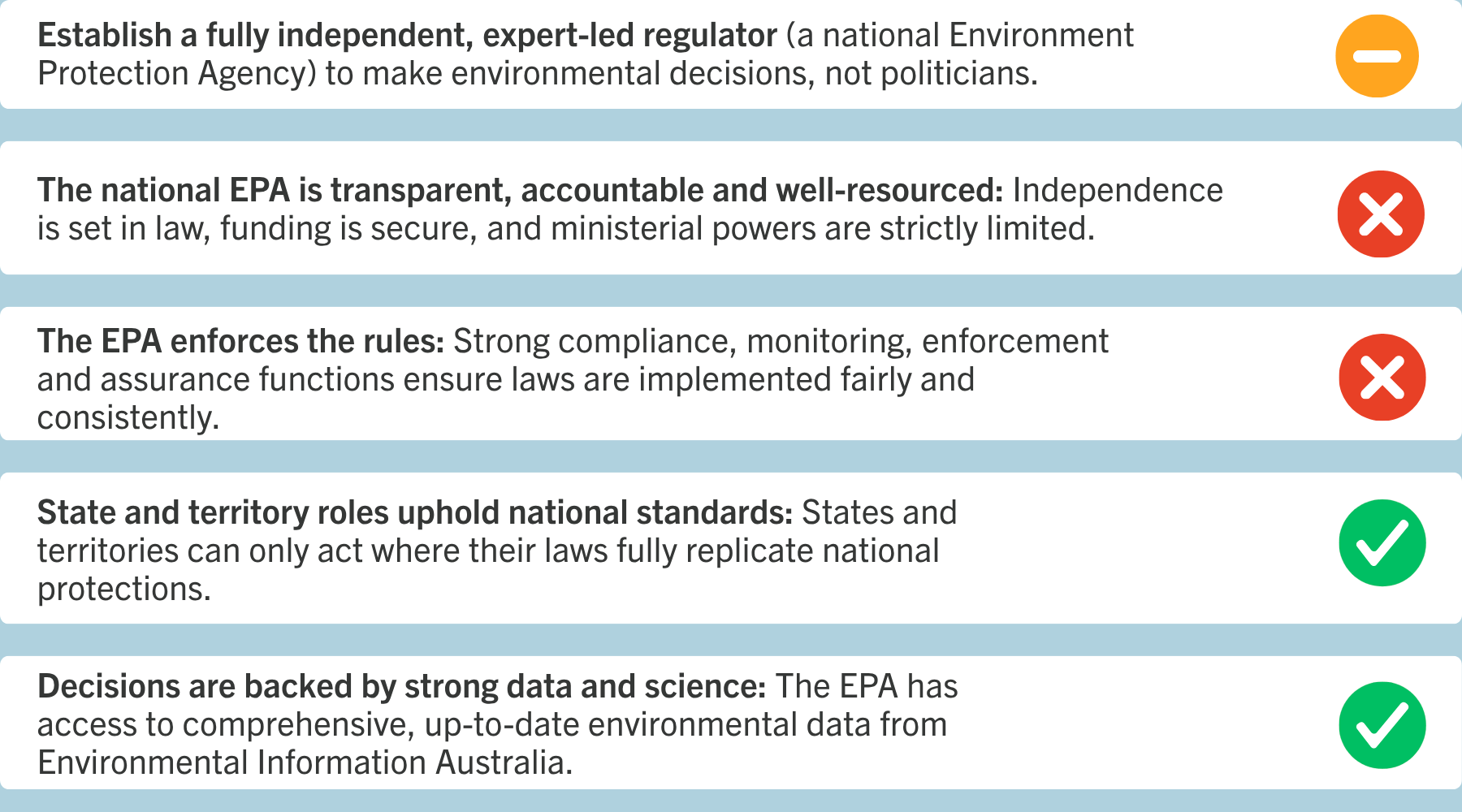
Right now, many other sectors have independent bodies to enforce the rules and oversee compliance – like ASIC, the Fair Work Commission and the Therapeutic Goods Administration. But there is no national watchdog for the environment. Instead, the Environment Minister has wide discretion to approve projects – even those with serious environmental risks – and decisions can be inconsistent and hard to predict.
So how does the draft reform package stack up?
Read the detail:
Right now, the current EPBC Act has vacuum of oversight. There are plenty of precedents that demonstrate the importance of an independent watchdog in other sectors – like ASIC, the Fair Work Commission and the Therapeutic Goods Administration.
But under the existing laws, there is no national watchdog for the environment. Instead, the Environment Minister has wide discretion to approve projects – even those with serious environmental risks – and decisions can be inconsistent and hard to predict. The federal Environment Department is responsible for compliance and enforcement, but action is slow or non-existent.
The Albanese Government’s proposed reform to create an independent protection agency is a positive step in the right direction.
The National Environment Protection Agency (NEPA) will undertake compliance and enforcement functions. NEPA will have new powers to issue environment protection orders and the reform package increases and improves penalties for those who break the law. NEPA may also undertake environmental assessments. NEPA may make project approval decisions, but only as a delegate of the Minister, not as an independent decision-maker with powers in its own right. NEPA will be led by a CEO with relevant experience, but won’t report to a board and rather will be operating under tight direction from the Environment Minister of the day. The Environment Minister will retain responsibility for approving projects.
The reforms would establish a Head of Environment Information Australia to lead improving environmental data and Australia’s State of the Environment reporting.
NEPA should be directed by an independent board, so it is not beholden to direction from the Environment Minister of the day.
Environmental assessments and approval decisions should be made by NEPA, not the Minister or the States and Territories.
The legislation should make it crystal clear that Ministerial overrides like national interest provisions should be strictly limited to rare, essential situations of genuine need.
A closer look
First Nations rights
Right now, Australia’s environment laws do not require the Free, Prior and Informed Consent of Traditional Owners to projects on their Country. That means major developments are approved without proper consultation, consent or respect for cultural values and rights.
So how does the draft reform package stack up?
Read the detail:
Australia’s current EPBC Act does not require the Free, Prior and Informed Consent of Traditional Owners to projects on their Country. That means major developments are approved without proper consultation, consent or respect for cultural values and rights.
The EPBC Act established the Indigenous Advisory Committee (IAC), appointed by the Minister to advise broadly on the operation of the Act.
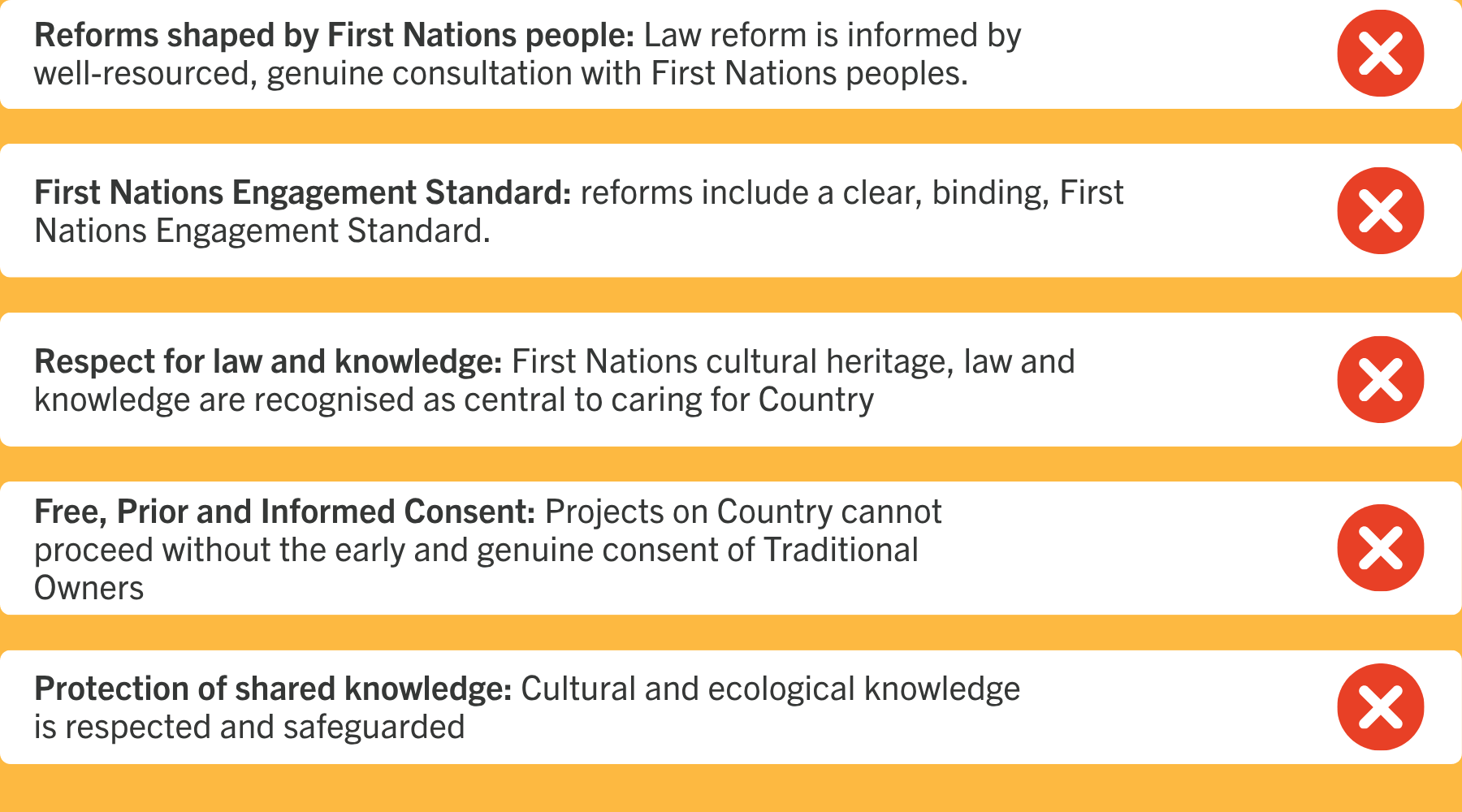
The reform package would expand the functions of the Indigenous Advisory Committee (IAC) to provide certain kinds of advice and information to the Minister, NEPA (the new National Environment Protection Agency) and others.
The IAC would be involved in development of the First Nations Engagement standard. Cultural knowledge will be incorporated into threatened species and ecological community listing processes.
The First Nations Engagement and Community Participation Standards are still in development and we don’t expect to see them this year. It is hard to see this can provide meaningful outcomes if it is retrofitted to the Act.
The Albanese government needs to undertake well-resourced and properly constituted consultation with First Nations people – and use this to inform amendments to their draft reforms.
Traditional Owners should have the right to decide what happens on their Country. They should be genuinely involved from the start of project planning. Where traditional ecological and cultural knowledge is shared, it must be respected and protected. Developers must have clear expectations – and projects must not proceed without Free, Prior and Informed Consent.
For example, reform could look like:
- Including a strong First Nations Engagement Standard.
- Recognising First Nations cultural heritage, knowledge and law as essential to caring for Country and environmental protection.
- Embedding Free, Prior and Informed Consent at the earliest possible stage in project planning.
A closer look
National leadership
The federal Environment Minister has a vital responsibility: the fate of nationally and internationally significant places, ecosystems, plants and wildlife. This includes species at risk of extinction, as well as places of deep significance for First Nations people, World Heritage sites, National Parks, the Great Barrier Reef Marine Park, internationally significant wetlands and marine environments.
The federal government is responsible for protecting these matters of national environmental significance from activities that could have a significant impact.
However, state and federal environment systems often overlap, conflict or leave dangerous gaps. Accredited arrangements (like NOPSEMA and Regional Forest Agreements) are failing to protect nature and are not held to consistent standards. The result is a patchwork of weak and inconsistent protections that leave nature exposed.
So how does the draft reform package stack up?
Read the detail:
While the federal Environment Minister is responsible for protecting matters of national environmental significance from activities with a significant impact, state and federal environment systems often overlap, conflict or leave dangerous gaps. Accredited arrangements (like NOPSEMA and Regional Forest Agreements) are failing to protect nature and are not held to consistent standards.
The result is a patchwork of weak and inconsistent protections that leave nature exposed.
More specifically, at the moment, state and territory governments cannot approve actions that would be caught by the ‘water trigger’ (unconventional gas and large coal mining developments that may have a significant impact on a water resource). This is essential because water resources are precious and cross jurisdictions. State and territory governments invest in and receive royalties from mining and gas project, so may have conflicts of interest in approving these projects.
The reform package:
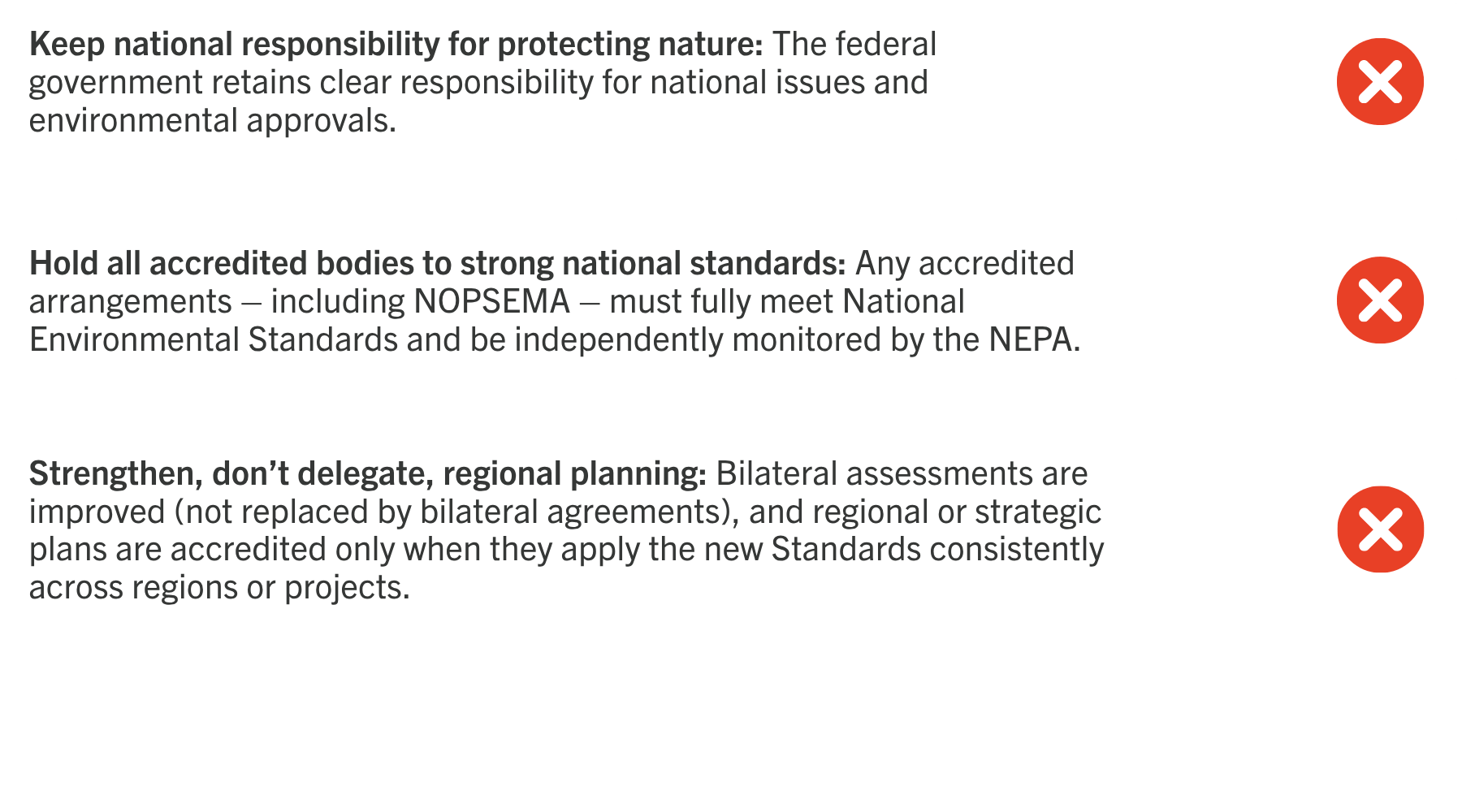
- Makes new provision for bioregional planning at a landscape or seascape scale, so that zones for development and conservation can be mapped. Reforms focussed on increasing environmental data and protection are welcome, but the ability of bioregional planning to deliver this remains to be seen.
- Includes scope for the federal Environment Minister to hand more power to state and territory governments, and non-government entities. The Minister can decide that certain actions don’t need EPBC Act approval based on arrangements with States and Territories.
- Lets state and territory governments approve unconventional gas and large coal mining developments that may have a significant impact on a water resource.
- Is too weak on how states and territories will be reviewed when they perform national environmental law functions.
The current draft reform package also includes a concerning new loophole that would enable the Environment Minister to switch off important safeguards for offshore gas and petroleum projects assessed by NOPSEMA (the National Offshore Petroleum Safety and Environmental Management Authority). This could have a significant impact on requirements for genuine consultation with First Nations communities and limit proper environmental assessment.
The federal government must stay responsible for protecting nature.
No handing power to states, unless they meet strong national standards and are independently monitored. States and Territories are not equipped for making decisions about national environmental matters, nor is it appropriate that they do so.
The test for whether state and territories are up to the job of assessing environmental impacts of projects must be based on objective standards, not be left to whether the Minister is satisfied or not. The laws must provide for the Minister or new National EPA to step in when there are conflicts of interest. Powers should not be given to non-government entities.
The existing exclusion of the water trigger from devolution to the States and Territories must remain in the EPBC Act and should not be removed. The new loophole that allows the Minister to decide that offshore projects don’t require EPBC Act approval must be removed. Requirements for proper consultation with impacted communities and environmental assessment must remain for these projects.
A closer look
Threatened species
Koalas, swift parrots, lungfish and platypus: Australia is one of the world's "megadiverse" countries. 85% of our wildlife is found nowhere else on Earth.
Yet more than 1,800 species and ecological communities are recognised as being in real danger of extinction in the near future – and the "threatened species list" keeps getting longer.
Our federal environment laws are meant to protect threatened species and their habitat from harm. Yet projects that harm and kill threatened species and destroy their habitat are routinely approved.
So how does the draft reform package stack up?
Read the detail:
The EPBC Act sets out the process to list species and ecosystem communities as threatened (either as vulnerable, endangered or critically endangered), as well as when and how to develop Conservation Advice and Recovery Plans to guide conservation planning.
Listed threatened species are "matters of national environmental significance" – and the Act requires the Environment Minister to give approval for actions that could have a significant impact on the species or their critical habitat.
Decisions, like project approvals, cannot be inconsistent with Recovery Plans and should take into account Conservation Advice.
However there is no system for "no-go" zones. Loopholes like Regional Forest Agreements alongside consistent failure to apply and enforce the EPBC Act mean destructive projects are routinely approved – or never assessed at all. These projects then kill threatened species and destroy their habitat, pushing the nature we love closer to extinction.
While offsets are not mentioned in the EPBC Act, there is an offsets policy that allows "biodiversity offsets" to be used as a condition on approvals, which means a development can offset damage to habitat by buying or restoring equivalent habitat elsewhere.
The current Act is often criticised for its over-reliance on biodiversity offsets, which have become a default rather than a last resort.
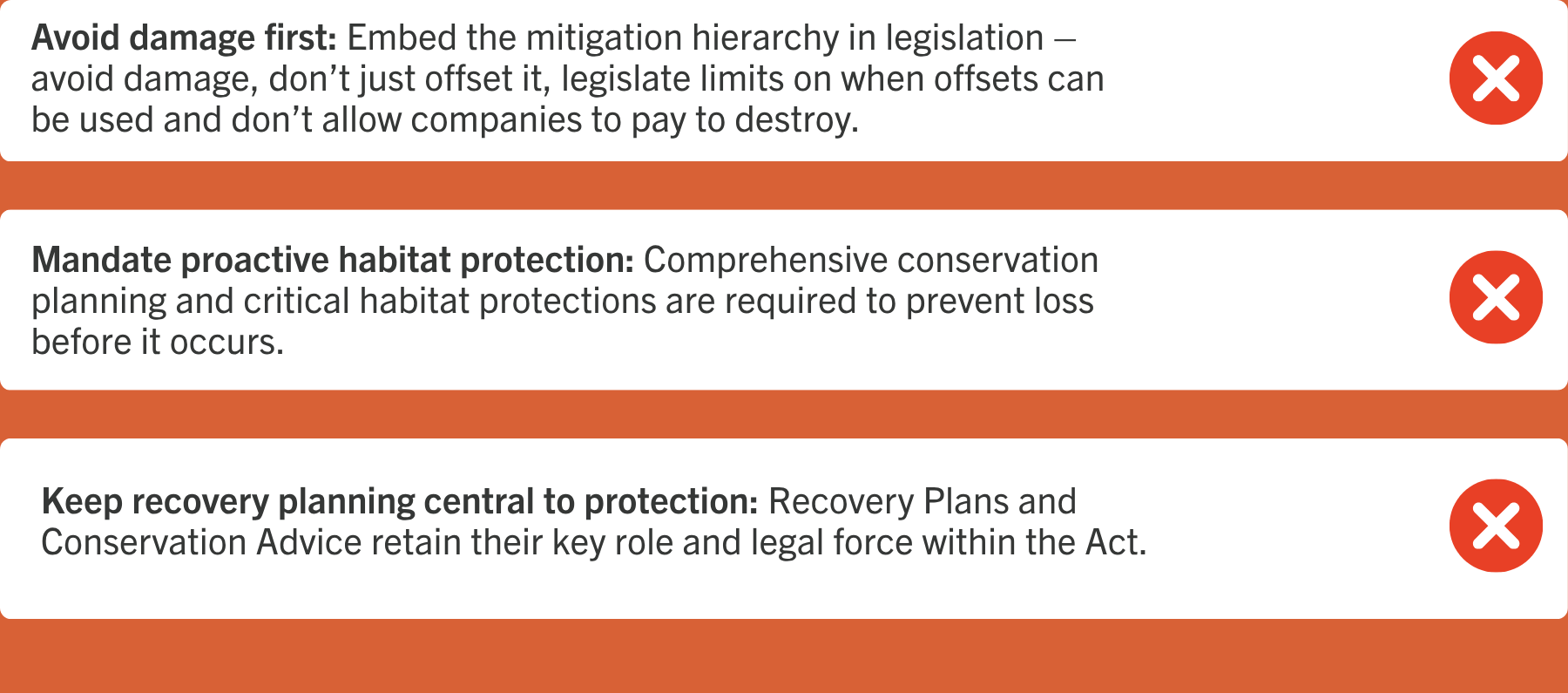
The inclusion of a mitigation hierarchy and concepts of unacceptable impacts and net gain in the reform package are welcome. However, the way they are defined and how they would operate means that there are real risks for nature.
Unfortunately offsets are expanded in the Albanese government's draft reform package.
Instead of requiring projects to try and avoid or reduce damage to habitat before resorting to offsets – the minister must only "consider" the "mitigation hierarchy" without being obliged to follow it.
Pay to destroy: A new “payment in lieu” offsets scheme would allow projects to be approved with no guarantee that genuine offsets will be delivered or that environmental outcomes will be achieved. Companies would be able to pay "restoration contributions" into an offset fund rather actually restoring or protecting equivalent habitat. In NSW, a similar fund has been criticised for collecting money that cannot be spent, as there is no suitable replacement habitat. Without safeguards, this risks becoming a pay to destroy scheme.
The reforms make provision for bioregional planning at a landscape or seascape scale, so that zones for development and conservation can be mapped. Reforms focused on increasing environmental data and protection are welcome, but the ability of bioregional planning to deliver this remains to be seen.
Broad discretion and lack of robust legislative criteria for in the making of bioregional plans mean that conservation zones lack integrity, and high-risk or harmful projects could be exempt from EPBC Act assessment and approval.
The reform package introduces a new ‘protection statement’ which is intended to be the “default primary document” for a decision-maker to consider in relation to threatened species and ecological communities. Protection statements could enable better, up-to-date information about species to inform decision-making.
However, the current reform package would see them diminish the role of essential tools, recovery plans and conservation advices, by overriding them including in project assessment and approval decisions. The process for making and revoking protection statements is weaker than for recovery plans and conservation advices, and is not required to be informed by the advice of the Minister’s Scientific Committee.
The reform package also includes the option that recovery plans can now be made for only part of a species or ecological community.
The Albanese Government should amend the draft reform package in these ways:
Offsets:
- Remove the pay-to-destroy offsets fund. Any offsets must achieve real like-for-like outcomes.
- Remove the option allowing companies to pay restoration contributions charges in lieu of offsets. If restoration contributions charges remain as part of the framework, there must be stronger upfront restrictions on the use of “pay-to-destroy" offsets.
- Embed key transparency and accountability measures in the legislation.
Bioregional planning:
- Bioregional plans must achieve genuine environmental protection and cannot be used as a carte-blanche to fast-track risky development.
- Insert robust requirements for upfront environmental assessment to inform bioregional planning.
- Put limits on what activities can be fast-tracked as priority actions (e.g. limit to low risk activities).
- Strengthen the role of conservation zones (e.g require certain values to be protected via conservation zones).
- Remove or tighten exemptions for restricted activities in conservation areas.
Conservation planning:
- Ensure conservation planning instruments are scientifically-based, binding and implemented.
- Protection Statements must complement, not override or diminish the role of existing conservation planning documents, such as recovery plans, threat abatement plans and conservation advices.
- Keep existing provisions in the EPBC Act that require the Minister to not act inconsistently with a recovery plan and have regard to a conservation advice.
The unacceptable impact definition must be improved if it is to ensure meaningful on the ground nature protection.
A closer look
A fair and transparent system
Communities, Traditional Owners and local groups are often the first to spot illegal clearing, pollution or harm to wildlife. They must have the tools and legal rights to act – because environmental protection depends on public power, not just political will.
So how does the draft reform package stack up?

Read the detail:
Right now, it's hard for communities to find out what’s happening to their environment, understand how decisions are made, or raise alarm when something’s gone wrong.
The law gives communities limited rights to participate, and even less power to hold decision makers to account.
The current EPBC Act is frequently criticised for giving almost unfettered discretion to the Environment Minister of the day – resulting in subjective, politicised and unpredictable decisions. Projects that will cause significant environmental harm to matters of environmental significance are routinely approved by the Environment Minister, and there are limited grounds to challenge the decision.
The Samuel review recommended tightening this discretion by adding standards – clear rules to guide decisions.
The reform package:
- Introduces a lot of broad discretion. For example, rather than the Act clearly saying that actions that are inconsistent with the national environment standards can’t be approved, it says actions can’t be approved unless “the Minister is satisfied” that it won’t be inconsistent. This kind of discretion was a key concern of the Samuel Review and it has only been made worse in the proposed reforms. This kind of language is dotted throughout the Bill and means that lots of good parts of the reform, on national environmental standards and defining net gain, are weakened in practice.
- introduces a power for the Minister or the CEO of the National EPA (NEPA) to make ‘rulings’ about how the Act is interpreted. This puts the Minister and NEPA CEO in a position like a judge. While there are other examples of this – the ATO makes tax-related rulings – the power here is open to exploitation.
- makes a new way for projects to be assessed, via ‘streamlined assessment’, downgrading environmental assessment and risking projects being waved through without proper assessment and or public consultation. High risk projects could be assessed under this pathway.
The national interest exemption has not been tightened. Instead, there are more circumstances when it may be available. A new national interest approval mechanism has been introduced, empowering the Minister to approve projects that they consider to be in the national interest, even if they don’t meet the requirements of the EPBC Act.
Australia’s environment laws must protect communities’ rights to access information, speak up, and act when the law is broken or not enforced – because accountability only works when the public can take part.
The reform package must be amended so that clear, objective tests give certainty about crucial aspects like how national environmental standards apply. The rulings power and streamlined assessment pathway should be removed from the reforms. The national interest exemption and approval power must be tightly constrained to protect against future misuse.
Write your submission to the Senate Inquiry
A Senate Inquiry is inviting public submissions between now and 5 December 2025 – and EJA's legal experts have made it easy to get writing.
Our submission guide walks you through the process, explains what’s at stake and highlights the five biggest fixes needed to make these laws actually protect nature.
See the step-by-step guide: www.envirojustice.org.au/have-your-say-epbc-reform-package

Continue reading...




Make a difference
The challenges we face are vast. The time to push for large-scale system change is now.
Our financials
We have a long-standing commitment to sound fiscal management, accountability and transparency.
We encourage you to investigate before you donate.
Join us
The law is a powerful tool to disrupt the status quo and make governments and corporations accountable.
Join us and let's build a radically better world.