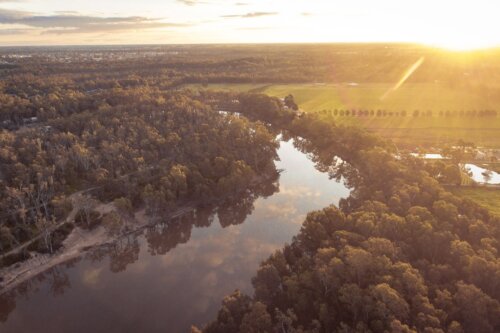
The Murray-Darling Basin Plan (the Basin Plan) is a national framework that aims to manage water across the Murray-Darling Basin and ensure enough water remains in rivers and wetlands to ensure they are healthy ecosystems.
The law requires the Basin Plan to be reviewed every decade, with the next review scheduled for 2026.
Environmental Justice Australia has worked on law and policy relating to the Murray-Darling Basin for many years – from the passage of the Water Act in 2007 and development of the Basin Plan, through to today.
A summary of key submissions
The Review
The style and manner of the Basin Plan Review (Review) to date have likely impeded rather than enabled public understanding and participation in the Review process.
The Report of the SA Royal Commission was and remains the authoritative assessment of the Murray-Darling Basin Plan (Basin Plan) and its administration to the date of its publication. The Murray-Darling Basin Authority (Authority/MDBA) should expressly engage with the key findings and analysis of the Royal Commission’s Report.
SDLs/ESLT and the scientific-technical base
There is a real risk the Authority is misdirecting itself on the proper or correct legal construction of the terms ‘sustainable diversion limit’ (SDL) and ‘environmentally sustainable level of take’ (ESLT) in its ‘assessment’ of SDLs for water resource units.
It is not open to the Authority to conclude on its ‘initial assessment’ that certain SDLs evaluated ‘continue to reflect an ESLT.’ Further, it is not open to the Authority to accept that SDLs, as set in 2012, provide a lawful or correct basis for the present Review or properly inform the Discussion Paper.
There are real questions as to whether the purported scientific basis of the SDL ‘assessment’ is sound.
It is not possible to conclude that the ‘initial SDL assessments’ informing the Review represent ‘best available science.’
The precautionary principle must be engaged in the task of setting the SDLs/ESLT.
The SDL range set out in the Guide to the Proposed Basin Plan (‘the Guide’) continues, in the absence of updated science, to provide the appropriate and valid recovery amounts (combined with confidence values).
The technical base (including ‘best available science’) informing the Review must include and address the full ambit of relevant peer-reviewed literature, its findings and opinions.
Environmental conditions in the Murray-Darling Basin
Actual conditions in water ecosystems of the Murray-Darling Basin (MDB) generally continue on a trajectory of decline. In certain circumstances, environmental outcomes may be stabilizing and, where approximations of natural flow regimes are reinstated, recovery can be shown. But overall outcomes are not improving and serious ecohydrological risk is evident in key ecosystems.
Environmental water holdings portfolios exhibit substantial risk, specifically as associated with the ‘reliability’ profiles of water holdings. Underpinning values of the interests held by environmental water holders (water entitlements) are overstated and environmental water holders may be said to be sitting on ‘sub-prime water.’ These are matters the Review should consider.
The SDLAM
The sustainable diversion limit adjustment mechanism (SDLAM) should be discontinued in its present form, with certain programs anticipated under the SDLAM (such as constraints relaxation and 450GL additional environmental water) being separately progressed and advanced under an amended Basin Plan.
Connectivity
Floodplain easements under a ‘constraints relaxation’ program must be progressed as a matter of priority, including as required or expedient, by way of compulsory acquisition of relevant property rights attached to private landholdings.
Good faith protections from liability for environmental water managers undertaking environmental watering actions should be established in all jurisdictions and/or through amendments to Commonwealth law.
Longitudinal connectivity of the northern rivers is the norm under natural and sustainable conditions. Water resource planning rules prioritizing environmental outcomes before ‘take’ should commence, setting out water infrastructure decommissioning and/or re-engineering programmes. Providing for improvements in water administration must be included in the Basin Plan, especially for northern MDB water planning areas.
Water infrastructure decommissioning programs should be identified and accounted for in the Review.
Water resource plans
Dilution of the regulatory scope and effect of water resource plans should be resisted. Water resource plans are inherently a prescriptive regulatory device within the cascading legal and policy architecture of MDB water resource management (with international environmental treaties at the apex of these arrangements).
The Water Act 2007 (Cth) (Water Act) and Basin Plan should be amended to require the Commonwealth Minister
Water resource plans must necessarily raise the standard of administration of Basin water resources, in recognition that Parliament intended Basin water resources to be managed in the national interest.
Water resource planning should include priority water rules safeguarding environmental water and watering outcomes and critical human water needs.
Managing climate risk
The ‘initial assessments’ of SDLs/ESLT do not reflect climate risk or provide a proper basis for climate risk management. The Basin Plan presently does not manage climate risk. SDLs/ESLT must be set in accordance with methods recognising and addressing unfolding and anticipated climate change and climate risk. Design and operation of priority rules for water planning under the Basin Plan (including water resource plans) must include measures accounting for climate change and climate risk. Under such rules, priority is to be given to protection of environmental water and ‘environmental watering requirements’ in management of Basin water resources.
The Basin Plan should provide for a mechanism of adjustment or indexation of the actual availability of water resources accounting for climate change impacts, including priority rules for water availability to critical human needs, the environment, and other consumptive needs (in that order).
Aboriginal water estates
Existing consultation provisions for Aboriginal peoples under the Basin Plan are seriously deficient. They convey neither the effective rights and interests of Aboriginal peoples in Basin water resources nor reflect relevant international law.
Basin Plan measures concerning Aboriginal rights and interests in Basin water resources must do so in the context of promoting the right to self-determination as it relates to those resources.
Basin Plan measures benefiting Aboriginal peoples should reflect relevant international instruments (including but not limited to the United Nations Declaration on the Rights of Indigenous Peoples (UNDRIP)). Whatever legal formulae are used, minimum legal standards must give effect both to effective procedure and exercise of power by Aboriginal people over Basin water resources decisions and programmes. Provisions for Aboriginal involvement in Basin water resources management must be capable of effecting actual outcomes and reflect the existence and exercise of an Aboriginal jurisdiction over Basin water resources.
In the Review, the Authority and Commonwealth should ‘consult in good faith in order to obtain consent’ of Aboriginal peoples in the MDB for any amendments to the Basin Plan.
Measures should be established by which Aboriginal cultural or traditional knowledge is incorporated into ‘best available science and socio-economic analysis.’
The Water Act should be amended to provide arrangements for Aboriginal people to submit administrative (policy) or regulatory measures to the Authority, for consideration by the Authority.
Critical human water needs and the right to water
The right to water (as a human right) should be incorporated into the Basin Plan and reflected in the design and operation of priority rules drafted into water resource plans.
Review of operation of the Water Act
Any review of the Water Act must be careful to avoid recommendations or outcomes that seek to mitigate or limit the legal effect of the Water Act in order to meet deficiencies in its implementation, including deficiencies in design or operation of the Basin Plan.