Murray-Darling Basin Plan review:
Your questions answered by experts
More than 160 people joined us for a national webinar unpacking the once-in-a-decade review of the Murray-Darling Basin Plan; a critical moment for the future of Australia’s largest river system.
Together we heard from experts across law, science, advocacy and First Nations leadership about what’s at stake and what needs to change.
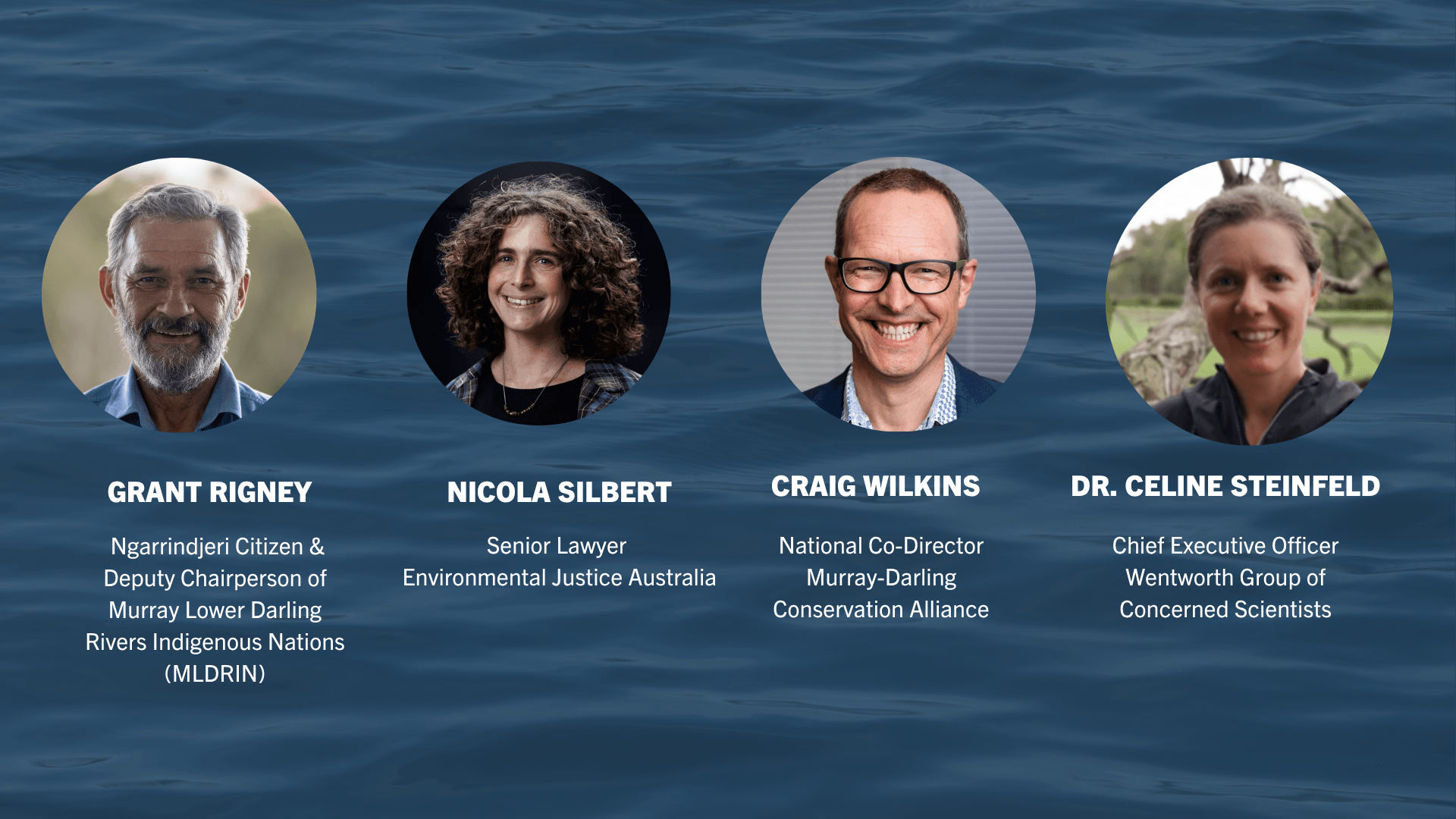
- Grant Rigney: Ngarrindjeri citizen and Deputy Chairperson of the Murray Lower Darling Rivers Indigenous Nations (MLDRIN), bringing on-Country knowledge and decades of leadership on water justice.
- Craig Wilkins: National Co-Director of the Murray-Darling Conservation Alliance, leading national advocacy to protect the Basin.
- Nicola Silbert: Senior Lawyer in EJA’s nature team, specialising in environmental and water law.
- Dr Celine Steinfeld: Chief Executive Officer of the Wentworth Group of Concerned Scientists, offering independent scientific expertise on river health.
Across the conversation, one message was clear: the Basin is in decline and this review is a rare chance to turn things around.
“The system is really unhealthy – let’s not be coy about it.”
Grant Rigney
Scroll down to watch the full recording and explore answers to questions we didn’t get to on the night.
Want to skip straight to action?

What we heard
The Murray-Darling Basin Plan was introduced to restore rivers after decades of over-extraction. But the evidence shows it’s falling short. Craig Wilkins summed it up: “...it’s been 10 years of lost opportunity.”
Only a fraction of environmental water needs are being met, putting ecosystems and communities across the Basin under pressure. Scientist Dr Celine Steinfeld explained: “Only 26% of environmental water requirements are being met.”
And the consequences are visible: from fish kills to drying wetlands and unsafe drinking water in some communities.
For First Nations leaders, the impacts are deeply felt on Country. As Grant Rigney said, “You could hear the Country screaming: ‘help me’.”
Your questions answered:
1. Is the Basin being properly protected?
Short answer: no. And not at the scale needed.
The Basin Plan was designed to return water to the environment, but progress has stalled.
- Only around two-thirds of promised water has been recovered
- Just 4% of wetlands receive the water they need
- In real terms, that means fewer flows reaching floodplains and wetlands – leaving rivers disconnected, native fish like golden perch struggling to breed, turtles losing nesting habitat, and waterbird colonies going without the conditions they need to survive.
That raises serious questions about whether current targets are enough, including whether higher recovery targets (like 4000 GL) are needed.
Climate change is also reshaping the system, but current rules don’t adequately account for it. As Dr Steinfeld noted, water planning still relies heavily on historical averages despite the fact that conditions have shifted.
Without reform, the gap between what ecosystems need and what they receive will continue to grow.
2. Sustainable Diversion Limits (SDLs): Are the current water limits working?
Short answer: no, and this is one of the most critical issues in the review.
Sustainable Diversion Limits (SDLs) set how much water can be taken from the Basin each year. Under the Water Act, they must be based on the best available science and leave enough water in rivers, wetlands and floodplains to keep the system healthy.
But those limits were set back in 2012 and experts say they no longer reflect the reality on the ground.
As Nicola Silbert explained:
“The Basin Plan is not meeting what the Water Act requires.”
While some water has been returned to the environment, many ecosystems remain in poor condition. There is growing evidence that current recovery levels are not enough to keep the Murray Darling Basin river system alive and healthy.
A key gap is climate change. Current SDLs are largely based on historical conditions, even as water availability declines and flow patterns shift. That raises serious questions about whether they still meet the legal standard.
Transparency is also an issue. The modelling behind these limits has not been fully released, making it difficult to assess whether they are grounded in robust science.
As Grant Rigney said:
“We need to start telling the truth of what’s happening here.”
This review is the chance to fix that – by resetting water limits in line with law, science and the reality of a changing climate.
3. Is the current Basin Plan fair and based on good evidence?
Not consistently and transparency is a major issue.
As Nicola Silbert explained,
“The Water Act creates legal requirements for this existing environmental degradation to be remedied and restored.”
The Basin Plan is legally required to use the “best available science”. But there are concerns about whether that standard is being met in practice.
There are also questions about how water limits are set, including whether the modelling behind them is publicly accessible or properly scrutinised.
Some claims about “environmental water” are also contested, particularly where water doesn’t reach the ecosystems it’s meant to support.
And not all systems are treated equally, with some rivers and flows excluded or poorly protected under current arrangements.
4. Who holds power and makes decisions?
Power is fragmented and often contested.
Water governance in the Basin involves federal and state governments, regulators, and water users, all with competing interests at play.
This creates tension between jurisdictions and raises questions about accountability.
Grant Rigney was direct about the underlying dynamics:
“This isn’t about doing the right thing. This is about power and control.”
Concerns were also raised about whether regulators have enough power and whether governments are being held to account when they fall short.
At the same time, First Nations Peoples – who have managed these systems for millennia – remain largely excluded from decision-making and water ownership.
5. How do we fix the system?
There are clear pathways but they require political will.
Water governance in the Basin involves federal and state governments, regulators, and water At the centre is the Water Act. As Nicola explained, the key issue is alignment. The Water Act sets a high legal standard to protect and restore the Basin. So, this review must ensure the Basin Plan rises to meet that standard, not that the law is watered down to match a plan that is falling short.
This is especially important because the Water Act itself is due to be reviewed soon. If the Basin Plan continues to fall short, there is a real risk that the law could be weakened to reflect that lower ambition, rather than lifting the Plan to meet the standard the law was designed to set.
The Basin Plan must meet its legal standard by:
- resetting water limits so they are based on the best available science
- returning more water to the environment to restore rivers and wetlands
- being transparent about the modelling and evidence behind decisions
- strengthening protections for key ecosystems across the Basin
Reform must also address water justice for First Nations peoples, whose rights and knowledge have been sidelined.
As Grant Rigney put it:
“We need to start telling the truth of what’s happening here… because if people don’t do that, we’re going to have the same systemic problems continuing over and over.”
This includes aligning the Basin Plan with the UN Declaration on the Rights of Indigenous Peoples by:
- recognising First Nations rights and interests in water
- supporting cultural flows and care for Country
- ensuring free, prior and informed consent in decisions that affect Country
Fixing the system means making sure the rules actually deliver healthy rivers and a fairer future.
6. How do people create change?
Public pressure matters.
The Basin Plan review is a formal process, but it’s also shaped by public momentum.
Craig described it as a rare opportunity:
“There is a real chance to help shape the politics – to bend it towards a healthy river.”
Submissions are one important step but they’re part of a broader movement.
Grant Rigney put it plainly:
“The power is in the people – if they don’t speak, nothing changes.”
Beyond submissions, change comes from sustained advocacy, community organising, storytelling, and holding decision-makers to account.
What happens next?
This review is a critical opportunity to push for stronger laws, healthier rivers, and water justice.
This is a rare chance for the community to push for stronger, fairer laws.
If you care about the future of the Murray-Darling, now is the time to act.