Legal update
Beetaloo fracking hearing day 4
Court summary
When: 9:30am, Thursday June 26
Where: Federal Court, Sydney (184 Phillip St, Sydney)
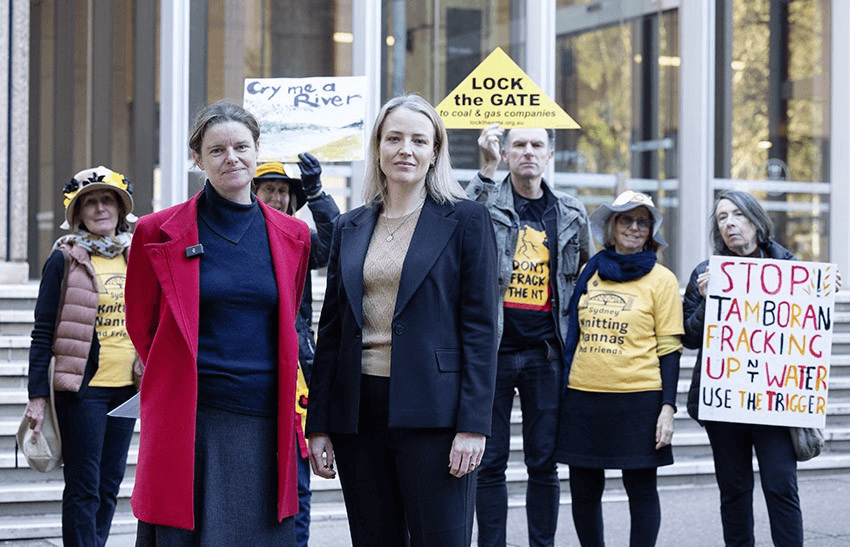
The hearing of the Gate’s landmark legal challenge protect water resources in the Beetaloo Basin continued today in the Federal Court in Sydney.
Lock the Gate’s Beetaloo fracking case has generated considerable public interest. These legal updates provide factual information about the hearing before the Federal Court that commenced on 23 June 2025.
Day 4
Expert evidence
Thursday 26 June was the fourth day of hearing before Justice Owens in the Federal Court in Sydney. The Court heard further evidence from the four experts on a number of technical issues relevant to the question raised by Lock the Gate’s application for an injunction: whether Tamboran B2’s proposed fracking project is likely to have a significant impact on protected groundwater.
Lock the Gate’s Beetaloo fracking case has generated considerable public interest. These legal updates provide factual information about the hearing before the Federal Court that commenced on 23 June 2025.
Further expert evidence
Characteristics of the Shenandoah South project’s gas wells
The morning’s evidence continued with questioning of the petroleum engineers, Mr Bradley Stout (independent expert engaged by Tamboran B2) and Mr Bernard McCloskey (independent expert engaged by Lock the Gate).
Mr Stout was questioned about the well design in the relevant geological context, including a drilling report showing the presence of a limestone cave where the well was drilled. Mr Stout accepted that Gum Ridge aquifer has greater permeability and subsequent ‘losses’ of drilling liquid than other kinds of formations.
Mr McCloskey also gave evidence that, whilst he does not have direct experience of drilling unconventional gas projects where limestone caverns exist at such a shallow level, from his review of well completion records from the Shenandoah South site, the extent of lost fluids and cement is ‘not something you see in other basins very often.’
Risk of a well-integrity failure
The questioning then moved onto the critical issue of the likelihood of a well integrity failure. A ‘well integrity failure’ in this context is, essentially, where barriers to an unconventional gas well fail and there is unintended fluid movement (or a leak) from the well into the surrounding environment.
As Mr Stout informed the Court, overcoming the difficulties that can lead to well seal failure depends on good well design and construction technique, and the application of appropriate technologies. He also agreed that the type of geology encountered in drilling can be a contributing factor to the degree of difficulty in overcoming these challenges.
The cross examination of the two petroleum engineering experts focused on the conclusions in their respective reports as to the statistical likelihood of a failure, and the methodology by which they reached those conclusions.
In Mr Stout’s written report, he indicated his opinion that the probability of a well integrity failure is 0.1 per cent, ie 1 in 1000. Under questioning from James Hutton SC for Lock the Gate, Mr Stout said he reached this figure not from an independent calculation based on available data but, rather, based on his experience in the industry and the failure rate observed from the number of wells he has ‘been around’. He then clarified that he reviewed different reports and different data, and observed that a lot of those cross-reference and match his own experience. He agreed that the figure of 0.1 per cent was his ‘gut feel’ based on what he has observed over the last 30 years of industry experience.
Mr McCloskey was then cross-examined by Mr Muston SC for Tamboran on how he reached his conclusion of an approximately 3 per cent probability of a well experiencing sufficient barrier failures to contaminate the Gum Ridge aquifer, amounting to a total probability of 37 per cent across the 15 wells to be drilled as part of the Shenandoah South Project.
Mr McCloskey was questioned in relation to his selection of data sets and method of analysis, and accepted there are some limitations in the available data including that it is challenging to find data on the likelihood of a well integrity failure leading to gas migration outside of a well bore.
Mr McCloskey was also cross-examined on the design of the wells in the Shenandoah South project, and acknowledged the multiple barriers to protect against integrity failures that are designed into this category of wells. He accepted that they are better designs than wells from previous eras, but also noted that these unconventional gas wells are “taking on quite significant challenges and stresses that other eras have not exposed those wellbores to”.
Monitoring
Next, the Court heard evidence from the hydrogeology experts on the proposed groundwater monitoring regime at the Shenandoah South project. The Court heard from Mr Andrew Moser (engaged by Tamboran) and Professor Matthew Currell (engaged by Lock the Gate) on the proximity of the monitoring bores to the project site, and on the frequency of monitoring.
‘Blow outs’
The final issue discussed was the risk of ‘blow out’, which is an uncontrolled release of fluids from a well, such as hydrocarbons or water. The Court heard from Professor Currell and Mr Stout in relation to their differing views of how likely a blowout is and the available research to indicate whether such an event would impact groundwater.
Next steps for the case
Thursday’s hearing brought the evidence phase of this litigation to a close. His Honour Justice Owens made orders setting dates for both parties to file final written submissions in the coming weeks, before both parties will return to a final day of hearing on 14 August for closing submissions on the legal issues in the case.
After the hearing for closing submissions, the parties will await the Court’s decision on whether the injunction sought by Lock the Gate – to prevent Tamboran B2 from continuing with its Shenandoah South Pilot Project without federal assessment and approval – will be granted.