A historic win for climate justice
Watershed ICJ ruling
A historic ruling from the world’s highest court has put governments – including Australia – on notice: climate inaction is no longer just a political failure, but a legal one.
In a groundbreaking opinion handed down today, the International Court of Justice (ICJ) confirmed that countries have binding obligations under international law to protect the climate system and reduce emissions in line with the 1.5°C temperature goal set out in the 2016 Paris Agreement. The ruling makes clear that wealthy, high-emitting nations cannot continue to delay action, or dodge responsibility – they must act.
It’s a major legal win that will likely shape global climate action for years to come, and a moment of hope for communities on the frontlines of the climate crisis.

Among those celebrating the ruling is Generation Justice spokesperson Maya Farmer – one of nine young Australians who this year made a formal complaint to the United Nations about Australia’s failure to act on climate, supported by Environmental Justice Australia.

— Maya Farmer, Generation Justice spokesperson
“This is a huge moment for young people who bear the burden of the climate crisis – the world’s highest court has confirmed countries must cut emissions or face the consequences.”
"Australia is on notice: it can’t keep greenlighting fossil fuels and wrecking the climate without accountability," adds Maya.
"We owe so much to the fierce young law students from the Pacific who took this to the ICJ - they’ve made history."
“This is a legal turning point for climate justice. The world’s top court has put wealthy and heavily polluting countries such as Australia on notice: they can’t delay and deflect any longer.”
— Environmental Justice Australia senior specialist lawyer Hannah White

“The court is clear: cut emissions, stop the harm and take responsibility. If governments don’t act, they risk breaching international law," says Hannah.
“States have an obligation to act now to reduce fossil fuel emissions and protect current and future generations.
“This ruling confirms climate change is a human rights crisis, and governments – including Australia – have a binding legal obligation to urgently act with robust climate action.
“This landmark legal statement demonstrates the power of young people leading the movement for climate justice. Their advocacy has led to a historic reshaping of international law which recognises that the rights of current and future generations must be protected in the context of climate change.”
What did the ICJ find?
The ruling stems from a request made in 2023 by the UN General Assembly for an advisory opinion from the ICJ. The court was asked two key questions:
- What legal obligations do states have to protect the climate system from greenhouse gas emissions, for both present and future generations?
- What are the legal consequences when states cause significant harm to the climate, particularly affecting vulnerable communities like those in small island states?
Today, the ICJ issued a resounding answer: States like Australia do have binding international obligations, and they go beyond what’s stated in climate agreements like the Paris Agreement. International human rights law and other treaties also impose clear duties on governments to protect and safeguard the world’s climate system.
Among the ICJ’s key findings:
- The 1.5°C goal is legally binding. States must take mitigation and adaptation measures consistent with this temperature limit under the Paris Agreement and international law.
- Climate pollution isn’t just harmful: it’s unlawful. States must prevent significant harm to the environment by acting with due diligence to limit greenhouse gas emissions.
- There are consequences. States may be required to provide full reparation to other nations harmed by their climate inaction – even when the damage comes from multiple sources.
- NDCs must be credible and aligned with the best available climate science. A country’s climate targets must be capable of achieving 1.5°C, and rich countries will be held to a higher standard based on their historic emissions.
- Governments must regulate private polluters. States must ensure companies under their control reduce emissions through proper laws and regulations.
Led by youth, driven by justice
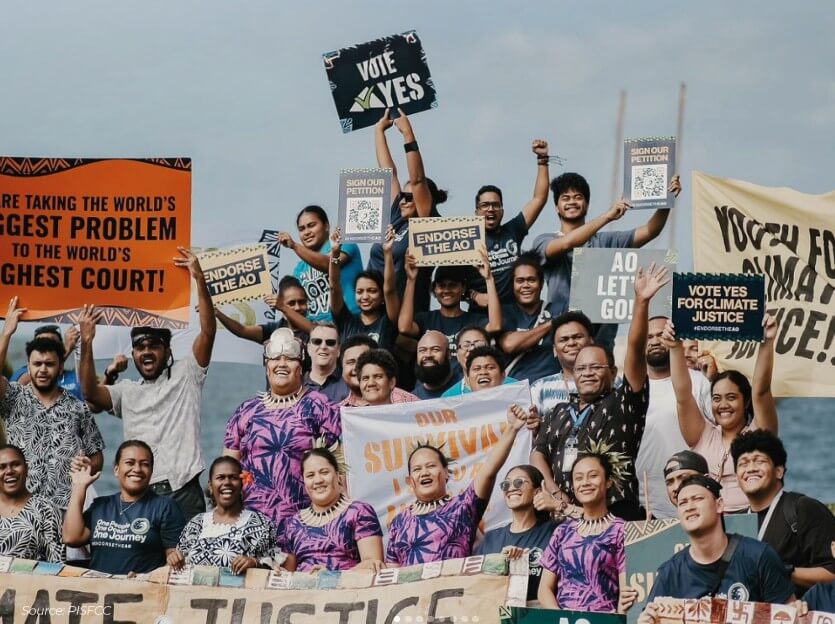
This case was made possible by a bold vision from the next generation. A group of young law students from the University of the South Pacific – backed by the Vanuatu government – initiated the push for an advisory opinion from the ICJ. Their goal: to clarify the legal responsibilities of governments, and strengthen the hand of communities demanding justice.
Their courage has paid off.
While many nations supported the case, several high-emitting countries (including Australia) argued existing frameworks were enough. The Court rejected that stance.
For frontline communities across the Pacific and beyond, including Generation Justice, the message from the ICJ is clear: the era of climate impunity is over.