EXPLAINER
What is the Hazelwood EES?
When Hazelwood closed in 2017, attention turned to one huge question: what happens now?
The power station’s operator, Engie, has put together the Hazelwood Rehabilitation Project proposal to outline how it plans to clean up the mine.
Victorian laws require these plans to navigate some important points of scrutiny before they’re approved – to ensure the community and environment aren’t left with a toxic legacy.
Project approval processes can be complex and hard to understand. This guide breaks down a key step Engie must complete before it can proceed with rehabilitating the Hazelwood mine: the Environmental Effects Statement (EES).
You’ll find an overview of the context and EES process, in-depth information about key public consultation points during the EES process, advice for participation and further resources.
While this guide is specific to the example of Engie’s Hazelwood rehabilitation, the EES process follows the same steps across all relevant projects in Victoria.
Contents
Background
Victoria’s environment laws require certain projects to undergo a specific environmental assessment before continuing the approval process. This assessment is called an Environment Effects Statement (EES). Under the Environment Effects Act 1978 (Vic), the Minister for Planning has the power to make the call on whether an EES is necessary.
On 2 December 2021, Engie referred its plans to rehabilitate Hazelwood – the Hazelwood Rehabilitation Project (HRP) – to the Planning Minister, who would determine whether the project required an EES.
The Minister decided Engie’s plans to rehabilitate Hazelwood do require an EES, for two reasons: the potentially significant and cumulative impacts on the environment, and the significant community interest in the project.
The next stage in the process took place across several months in 2023: determining the scoping requirements. Scoping requirements set out what a proponent must include in the EES. The finalised scoping requirements, released in October 2023 after consultation with the community, outlined five areas the EES must pay close attention to:
- Water resources and environmental values
- Cultural heritage (both Aboriginal cultural heritage and historic heritage)
- Landform safety and stability
- Amenity, socio-economic considerations and land use
- Biodiversity and ecological values
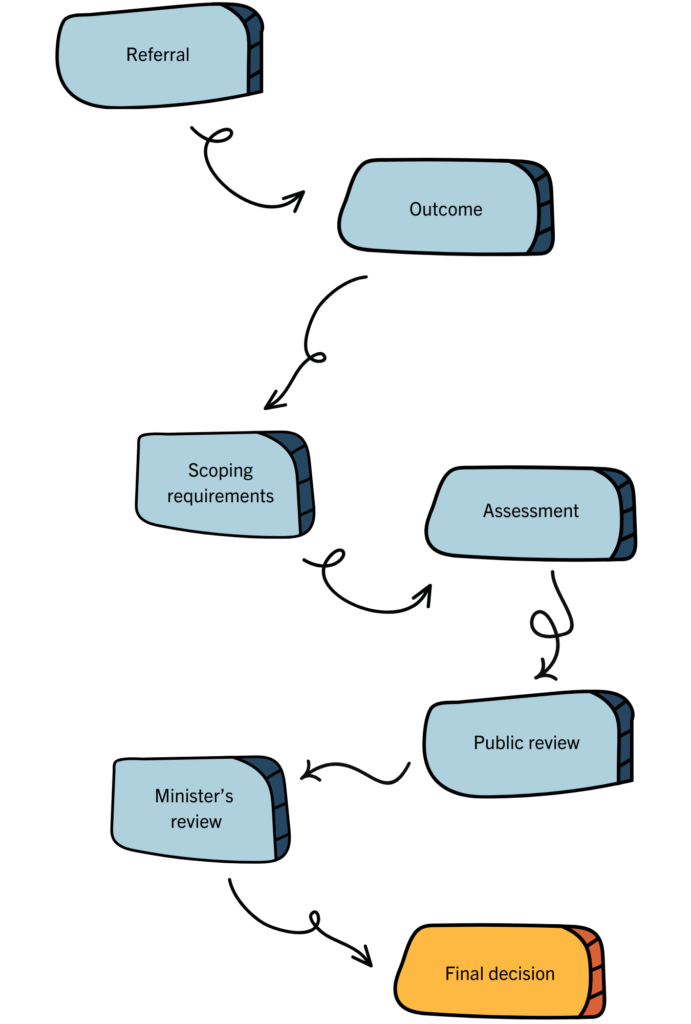
Engie is now preparing the EES. Public consultation is expected to take place in September/ October 2026 , followed by a public inquiry process. The Minister’s review will follow this, and finally, the decision-makers will decide whether Engie can proceed with its Hazelwood Rehabilitation Project.
Referral
The project is referred to the Minister for Planning for decision on whether an EES is required.
Outcome
The Minister for Planning makes a decision on whether an EES is required.
Scoping requirements
The scoping requirements – or what areas the EES must cover – are drafted, exhibited and finalised.
Assessment
The proponent prepares the impact assessment and conducts required studies.
Public review
The community reviews the EES.
Minister's review
The Minister for Planning reviews the EES.
Final decision
The decision-maker(s) decide whether to approve the project.
Public consultation and submissions
Once the EES is prepared, the community will have an opportunity to review it and provide feedback. This process happens in four steps:
- Public notice: the project’s proponent must inform the public of the EES – known as ‘giving notice’ – and invite submissions. There are some important requirements to giving notice:
- The proponent must place an advertisement in a daily newspaper and, for regional projects such as the Hazelwood Rehabilitation Project, in one or more local papers.
- The notice must include when and how to make submissions
- The EES must be adequate for public review, which includes ensuring it addresses all of the areas outlined in the scoping requirements.
- Exhibition: the EES is shared with the public for review for a consultation window determined by the Minister. This is usually 30 business days, but a Minister can require an EES be displayed for longer periods.
- Receipt: (who?) receives the public’s submissions.
- Inquiry: an inquiry takes place after submissions have been received, in a form determined by the Minister.
Written submissions are the first of two opportunities the community will have to provide feedback on the EES. As part of giving notice to the public, the project’s proponent must outline when and how people can make submissions. There are a few things to keep in mind when it comes to submissions:
- When writing a submission, you should cover all the views and information you consider relevant to the assessment of the proposal. This may include background or contextual information, information related to the scoping requirements, or anything else you feel must be considered.
- Organisations or groups that want to address similar issues are encouraged to make a submission as a group that covers all issues, rather than as individual members or individual groups if there is close crossover.
- Petitions and pro-forma or pre-filled submissions will be treated as a single submission – so always ensure your submission is unique.
See our submission writing guides here for advice on making an impactful submission. Generally, we encourage you to:
- Make sure you introduce yourself.
- Outline why this issue matters to you.
- Summarise your key points and recommendations at the top of your submission, and then expand on them in detail later.
- Always read the terms of reference before drafting your submission.
It’s worth keeping in mind that submissions are public documents will be therefore made publicly available, except in circumstances where they can be confidential – for example, in the case of sensitive information.
After the project proponent has received the submissions, it is required to provide the Minister with its response to issues raised in public submissions. If the proponent wishes to negotiate a resolution to concerns raised, this negotiation should take place before the inquiry commences, if possible.
After receiving submissions, the Minister will decide what form the inquiry will take. Inquiries may happen as either written submissions (in addition to written submissions made during the exhibition stage), by submitter conference, or by public hearing. Proponents are expected to cover the costs of the inquiry.
The Minister may appoint one or more people with relevant expertise to run an inquiry into the Project proposal’s potential environmental effects. The Minister will set the terms of reference for an inquiry.
At the end of the inquiry, the inquiry overseers(s) will provide the Minister with a report of the inquiry’s findings and recommendations. This is usually released to the public at the same time as the Minister’s assessment.
Inquiry by public hearing
For Engie’s Hazelwood Rehabilitation Project, the Department has indicated a public hearing is the most likely option for the inquiry. This is because Ministerial Guidelines indicate a public hearing is usually warranted for an EES.
A public hearing gives the proponent and those who have made submissions the opportunity to speak about the project and raise concerns directly with representatives of the proponent. The hearing must consider the EES, submissions received and the proponent’s responses.
Public hearings are intended to be run in an open and equitable manner, and are run informally – meaning participants do not require legal representation.
Expert witnesses may attend to present evidence and by cross-examined or asked clarifying questions.
The hearing may also present opportunities for concerned parties to reach agreements with the project proponent about how certain issues will be managed.
Minister's assessment
After the public review period has ended, the Minister will provide their assessment of the EES.
The Minister will consider:
- The EES and any supplementary statement
- Public submissions, the proponent’s response to public submissions, and supporting information from the proponent and submitters
- The inquiry report
- The principles of ecologically sustainable development
The Minister’s assessment will include:
- Their opinion on the project’s acceptable environmental impacts
- Their opinion on the project’s unacceptable environmental impacts
- Whether the project would require major modifications and/or further investigation to demonstrate that it would have acceptable environmental outcomes
If the project will have unacceptable environmental impacts, or requires major modifications, this may require the proponent to go through the assessment process again from the referral stage.
The Minister’s assessment decision will be published on the Department of Transport and Planning’s website. This is not the ultimate approval decision for the project – rather, it is an assessment intended to inform decision-makers of relevant environmental matters when they consider project approvals.

In Victoria, three huge coal mines need rehabilitation in coming years.
Properly rehabilitating these mines is a significant opportunity for the region – creating good local jobs, diverse and resilient economic opportunities, connecting communities, restoring the land, improving biodiversity and creating vibrant places the whole community can enjoy.
The Latrobe Valley community is fighting for a future free from the burden of coal pollution.
Decision-maker makes decision
After the Minister has provided their assessment, it is up to the relevant decision-makers to make their decision on whether the project should be approved or refused.
Decision-makers are required to consider the Minister’s assessment, but they are not bound by its recommendations.
Resources
For more information on the EES process, and Engie’s approach to its Hazelwood rehabilitation plans, you can explore the following links. These include links to completed stages of the HRP EES – including the scoping requirements and initial referral to the Minister.
Victorian State Government, Making the final assessment (online, September 2024)
Victorian State Government, Ministerial guidelines for assessment of environmental effects under the Environment Effects Act 1978, 8th Ed., 2023 (online, September 2024)
Victorian State Government, Public review of an EES (online, September 2024)
Victorian State Government, Scoping and preparing and EES (online, September 2024)
Victorian State Government, Understanding the assessment process (online, September 2024)
ENGIE, Hazelwood Rehabilitation Project – Environment effects statement process, July 2023 (online, September 2024);
ENGIE, Referral of a project for a decision on the need for assessment under the Environment Effects Act 1978, dated 2 December 2021 (online, September 2024)
Environment Effects Act 1978 (Vic);
Department of Transport and Planning, Reasons for decision under Environment Effects Act 1978 (referral number 2021-R06), dated 3 February 2022 (online, September 2024)
Draft scoping requirements Hazelwood mine rehabilitation project EES (online, September 2024)
Final Hazelwood EES Scoping Requirements (online, September 2024)
Hazelwood EES Scoping Requirements FAQ (online, September 2024)
Victorian State Government, Hazelwood Rehabilitation Project (online, September 2024)